

Building Trust Signals for SEO: How to Improve Rankings, Clicks, and AI Visibility
Trust signals are the elements on your website and across the web that prove your business is real, credible, and worth choosing. They help users feel confident, help search engines evaluate reliability, and help AI systems decide whether your content is worth citing.
If your site lacks clear trust signals, it becomes harder to rank, harder to convert traffic, and far less likely to appear in AI-generated answers.
That’s because modern search does not just evaluate keywords and backlinks. It evaluates credibility, consistency, and proof.
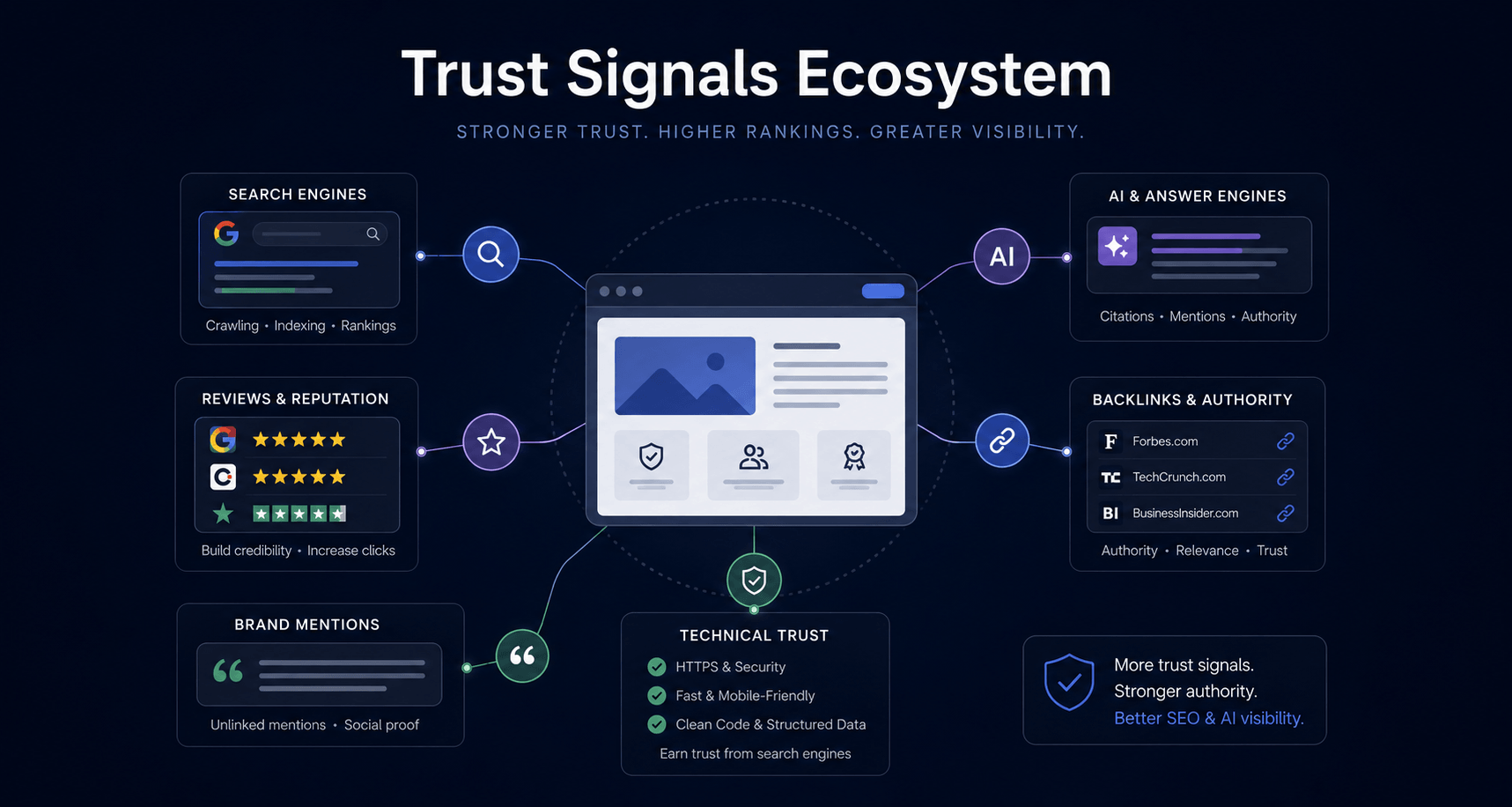
Google’s own guidance reinforces this shift. Its ranking systems prioritize helpful, reliable content, and AI search features like AI Overviews rely on the same core SEO fundamentals¹. In other words, there is no separate “AI SEO” strategy. The sites that build strong trust signals are the ones that perform across both traditional search and AI-driven results.
At the same time, the way people discover businesses is changing quickly. AI platforms are already sending over a billion visits per month, and those platforms tend to surface brands that show clear authority, strong reputation, and consistent signals across the web.
This is where most businesses fall short.
They focus on traffic and rankings, but they do not build the underlying trust signals that actually influence:
- Whether someone clicks
- Whether they convert
- Whether search engines continue to rank them
- Whether AI systems include them in answers
This guide breaks down what trust signals actually are, which ones matter most, and how to build them in a way that improves both SEO performance and AI visibility.
Quick Takeaways
- Trust signals help search engines, users, and AI systems evaluate credibility
- Strong trust signals improve rankings, click-through rates, and conversions
- Google and AI search rely on the same foundational SEO signals
- Reviews, backlinks, author clarity, and proof-based content carry the most weight
- Trust is not one element. It is built through consistent signals across your entire presence
What Trust Signals in SEO Actually Are
A Simple Definition
Trust signals in SEO are the elements that show your website, your business, and your content can be trusted.
They answer three core questions:
- Who is behind this content?
- Is this business legitimate?
- Can I rely on this information or service?
Search engines use these signals to evaluate credibility. Users use them to decide whether to engage. AI systems use them to determine whether your content is worth including in an answer.
If those signals are weak or missing, everything else becomes harder. Rankings are less stable. Click-through rates drop. Conversions suffer.
Trust vs Authority vs Reputation
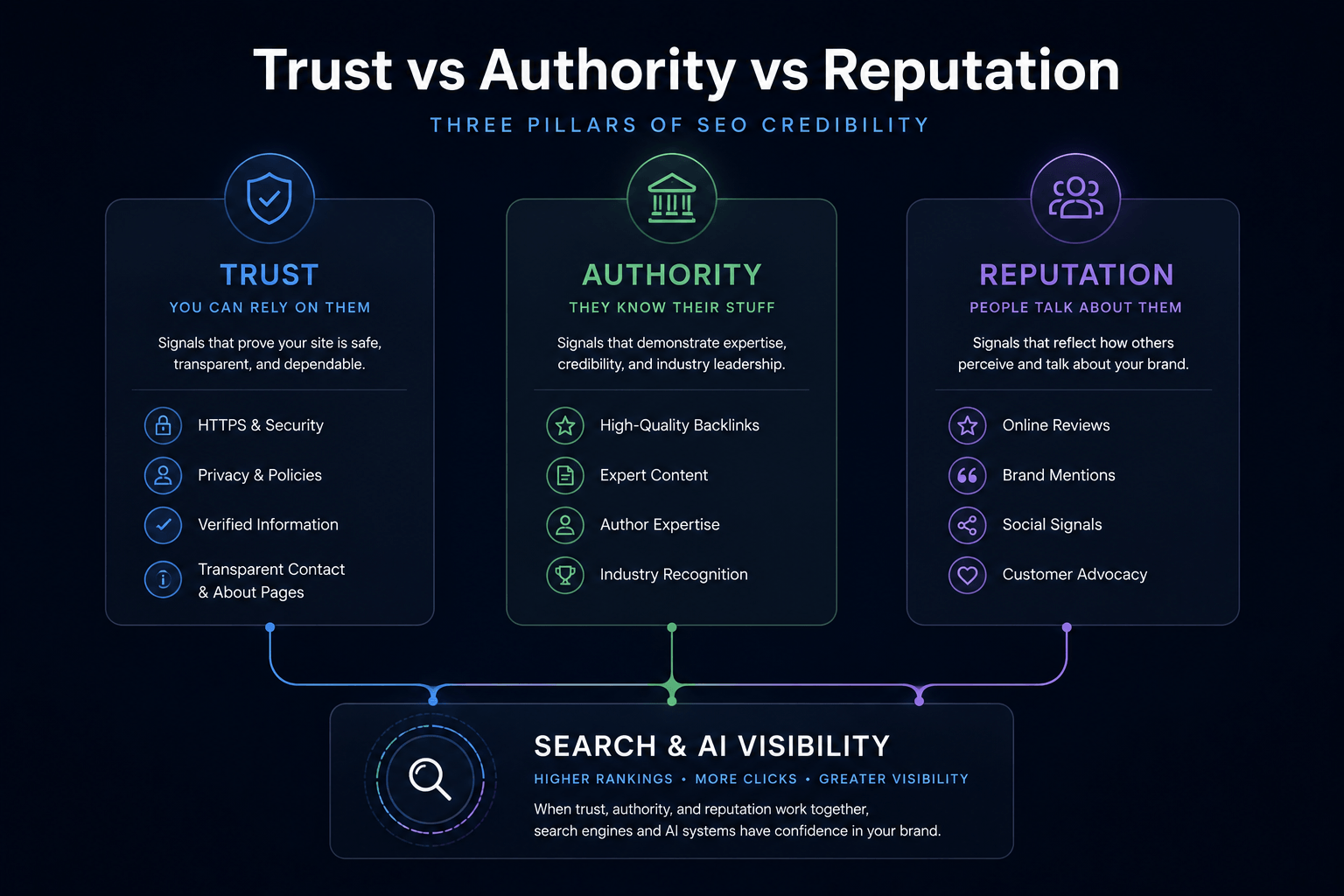
These terms get used interchangeably, but they are not the same. Understanding the difference helps you build them intentionally.
| Signal Type | What It Means | Example |
| Trust | Can I believe you? | Reviews, policies, authors |
| Authority | Do you know your topic? | Backlinks, expertise, content depth |
| Reputation | What do others say about you? | Mentions, ratings, brand searches |
- Trust is the foundation
- Authority is built on expertise
- Reputation is earned externally
You need all three working together.
You can have strong content, but if there is no clear business behind it, trust is weak.
You can have backlinks, but if reviews are poor, reputation is weak.
You can have a real business, but without authority, rankings will struggle.
Why Trust Is the Center of E-E-A-T
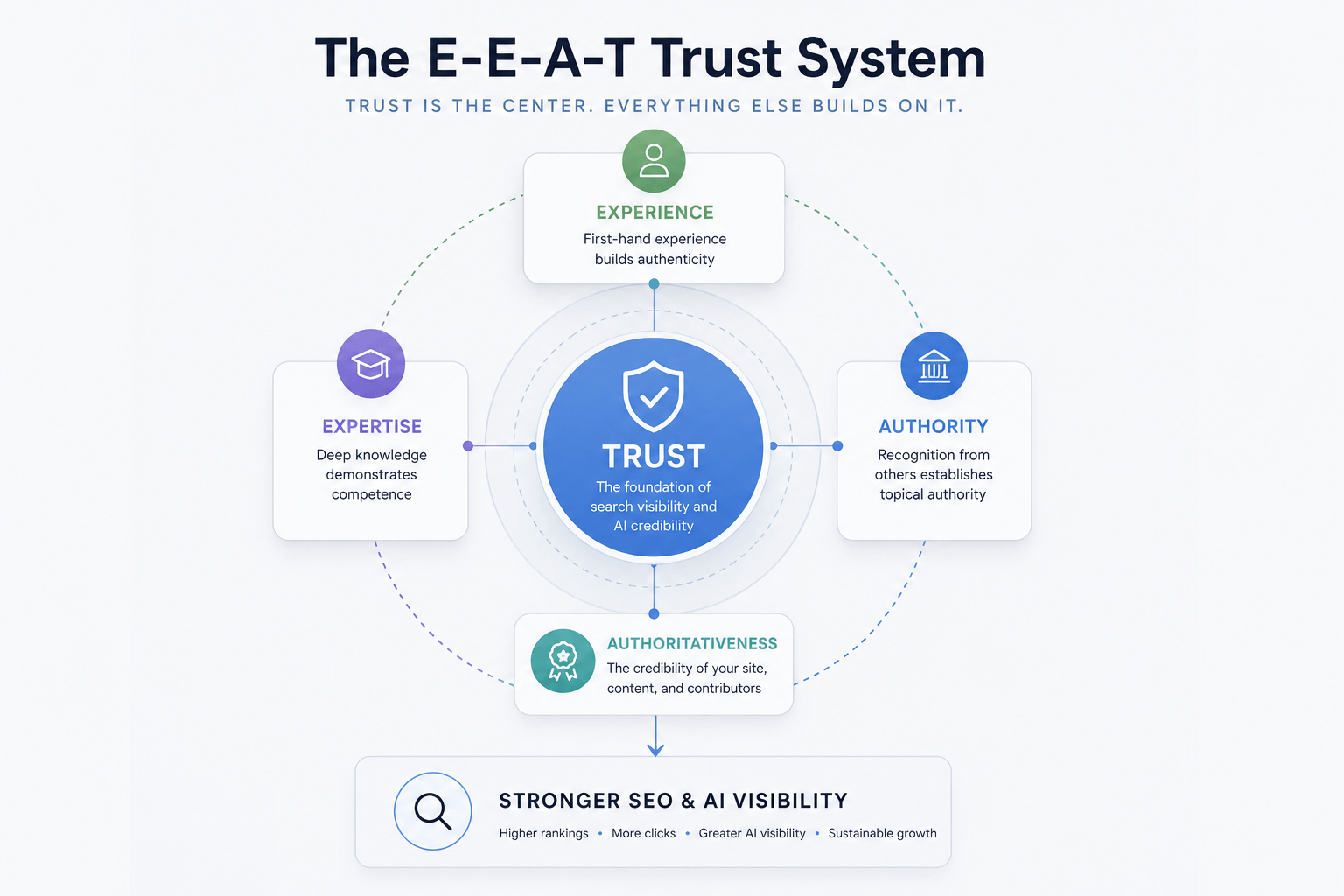
Google’s quality guidelines place Trust at the center of E-E-A-T (Experience, Expertise, Authoritativeness, Trustworthiness).
That is not accidental.
Trust is the signal that validates everything else:
- Experience shows you have done the work
- Expertise shows you understand the topic
- Authority shows others recognize it
- Trust confirms it is all real and reliable
This is why trust signals show up across multiple parts of your website:
- Clear business information
- Author attribution
- Real-world proof (photos, case studies)
- Reviews and testimonials
- Transparent policies and contact details
And this is also why they matter for AI visibility.
AI systems do not “trust” content the way people do. They rely on patterns of consistency and corroboration across sources. If your business, your content, and your reputation align across the web, you are far more likely to be included in answers.
If those signals are inconsistent or missing, you are far less likely to be surfaced — even if your content is technically optimized.
Why Trust Signals Matter More Now
Search Is Evaluating Credibility More Aggressively
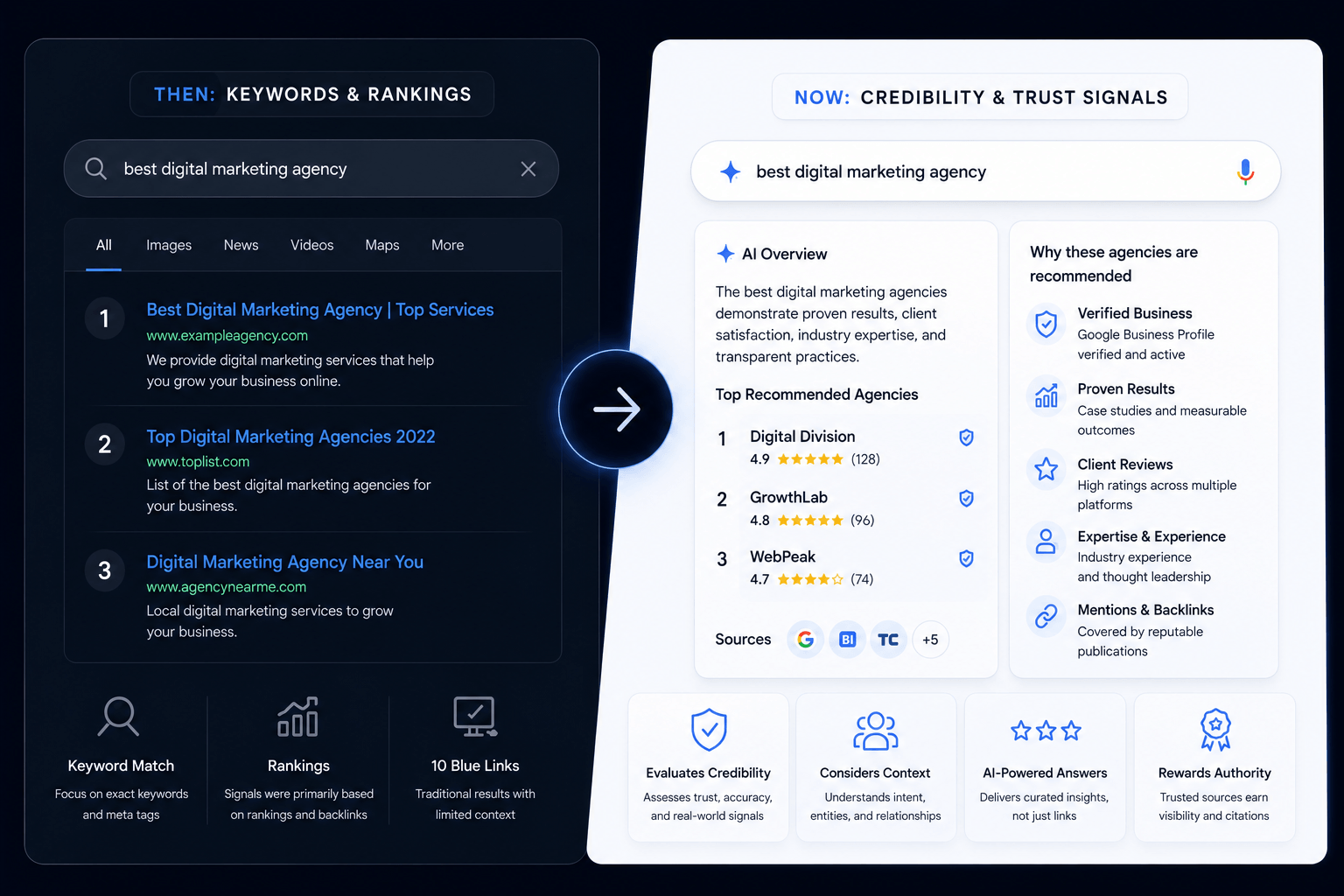
Search engines are no longer just matching keywords. They are evaluating whether your content is reliable enough to rank consistently.
Google has been clear about this direction. Its systems prioritize helpful, people-first content and reward pages that demonstrate credibility, transparency, and real-world relevance.
That means:
- Thin or generic content struggles to compete
- Anonymous or unclear authorship weakens trust
- Lack of proof (reviews, case studies, real examples) limits performance
In competitive industries, this becomes a deciding factor. When multiple pages target the same keywords, the one with stronger trust signals often wins.
AI Visibility Depends on Citation-Worthy Content
AI search changes how visibility works.
Instead of just ranking pages, AI systems:
- Pull information from multiple sources
- Combine it into a single answer
- Select which brands or websites to reference
To be included, your content needs to be clear, credible, and easy to verify.
This is where trust signals play a direct role.
AI systems look for:
- Consistent business information across sources
- Recognizable brands and entities
- Content that aligns with other trusted references
- Structured, easy-to-parse information
Google has stated that AI features like AI Overviews rely on the same foundational SEO signals. Microsoft and OpenAI guidance reinforces this. Strong SEO fundamentals, including clarity, structure, and credibility, increase the chances of being surfaced.
This is also why visibility is no longer tied only to rankings.
Even if you rank well, you may not be cited.
But if your content is trusted, structured, and corroborated, you can appear in AI-generated answers across multiple queries.
Trust Improves Clicks, Not Just Rankings
Getting traffic is only part of the equation.
Trust signals directly influence what happens after your page appears in search.
When users see your result, they are quickly evaluating:
- Do I recognize this brand?
- Does this look legitimate?
- Can I trust this company?
Strong trust signals increase:
- Click-through rates
- Time on page
- Conversion rates
Weak trust signals create hesitation, even if rankings are strong.
This is where many SEO strategies fall short.
They focus on getting traffic, but not on building the credibility needed to turn that traffic into leads and revenue.
The Shift: From Optimization to Validation
SEO used to be about optimizing pages.
Now, it is about validating your business across your website and the web.
That includes:
- Showing who you are
- Proving what you do
- Demonstrating results
- Building a consistent reputation
This shift is what connects traditional SEO performance with AI visibility.
Search engines rank what they can evaluate.
AI systems surface what they can trust.
The Four Types of Trust Signals That Matter Most
Not all trust signals carry the same weight.
Some help users feel confident. Others help search engines evaluate credibility. The strongest ones do both.
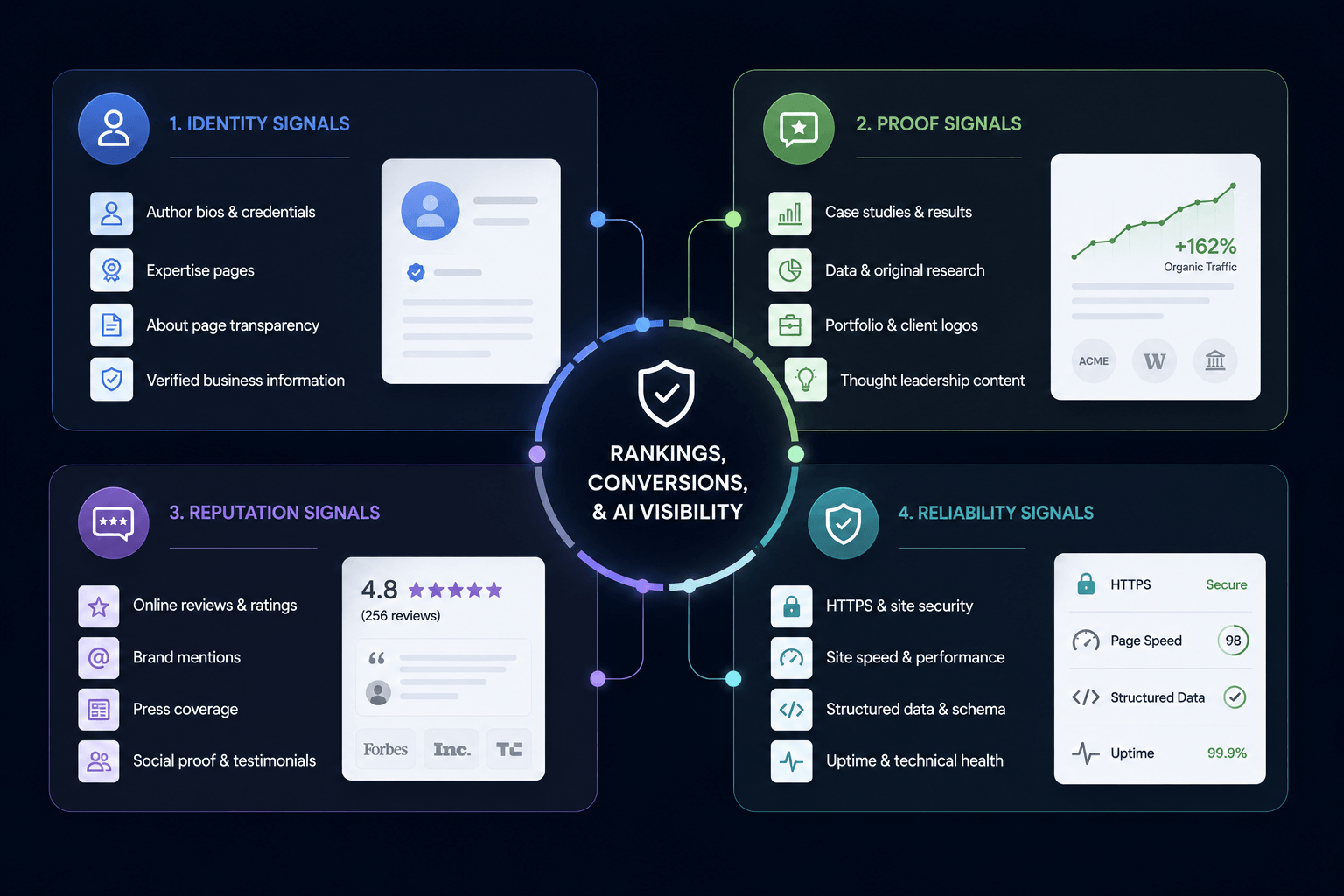
Instead of treating trust signals as a long checklist, it’s more useful to group them into four categories:
- Identity signals - Who you are
- Proof signals - What you’ve done
- Reputation signals - What others say about you
- Reliability signals - How your website performs
When these four areas are aligned, your site becomes significantly easier to trust, rank, and surface in AI results.
Identity Signals
Identity signals make it clear that your business is real, established, and accountable.
They answer the question: “Who is behind this?”
Key examples include:
- About page with real business details
- Clear contact information (address, phone, email)
- Service areas or locations
- Author names and bios
- Team pages or leadership profiles
- Consistent branding across your site and listings
These signals matter more than most businesses realize.
If Google or an AI system cannot clearly identify:
- who owns the site
- who wrote the content
- where the business operates
It becomes harder to trust and rank that content.
Consistency is critical here. Your business name, address, and core details should match across your website, Google Business Profile, and third-party listings.
Proof Signals
Proof signals show that your business delivers real results.
They answer the question: “Can you actually do what you say?”
This is where many websites fall short. They make claims but provide little evidence.
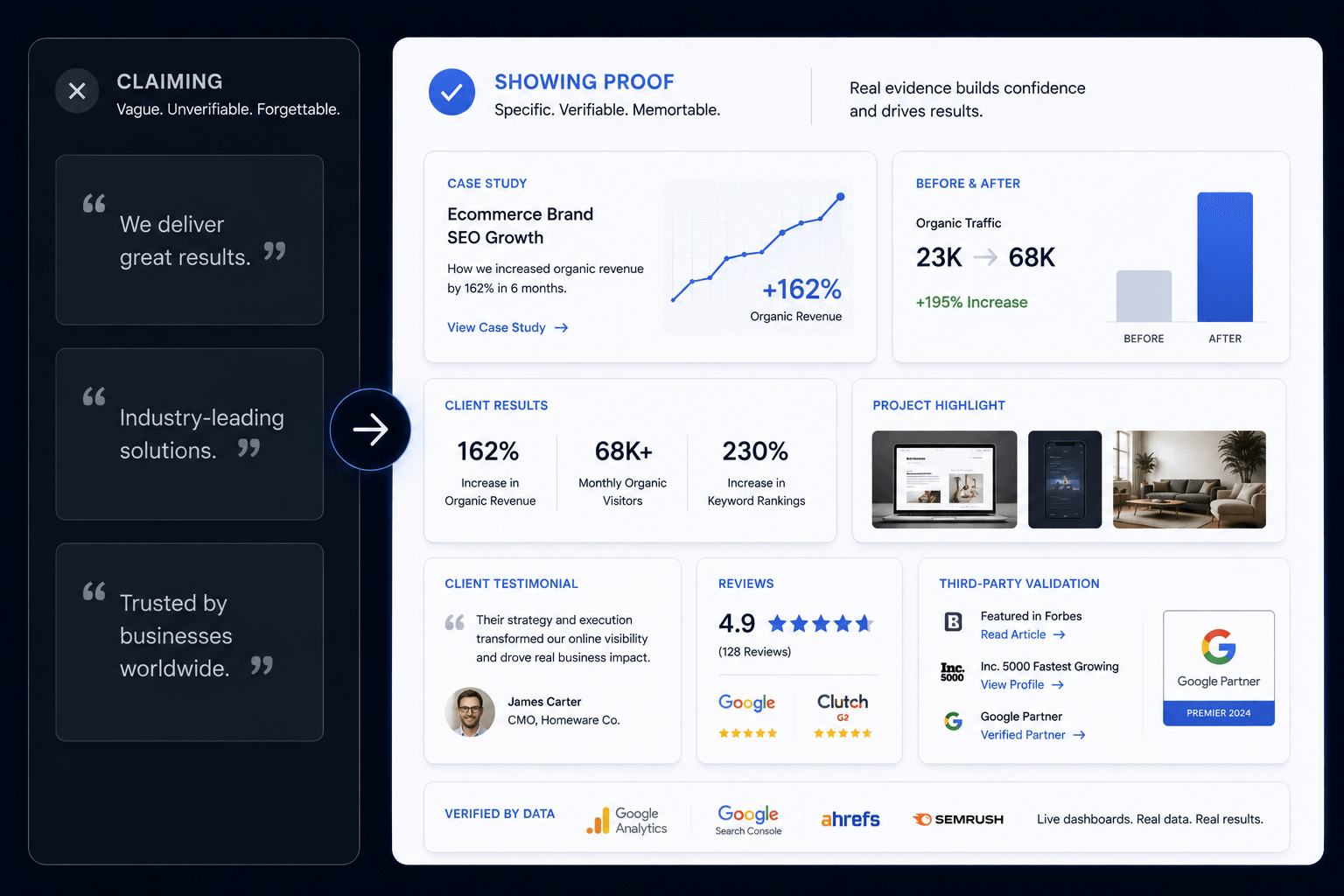
Strong proof signals include:
- Case studies with measurable results
- Before-and-after examples
- Original photos (not stock images)
- Client success stories
- Portfolio work
- Data-backed outcomes
These signals do two things:
- Build trust with users
- Reinforce credibility for search engines
They are also highly valuable for AI visibility.
AI systems favor content that includes specific, verifiable details rather than vague statements. The more concrete your proof is, the easier it is to surface and cite.
Reputation Signals
Reputation signals reflect how your business is perceived externally.
They answer the question: “What do others say about you?”
These are some of the strongest signals for SEO performance.
Key examples include:
- Customer reviews (Google, Yelp, industry platforms)
- Star ratings and review volume
- Backlinks from relevant, trusted websites
- Brand mentions (even without links)
- Press coverage or features
- Industry affiliations or certifications
Google has explicitly stated that links and reviews contribute to prominence, especially in local search.
This is also where authority builds over time.
You cannot fully control reputation signals, but you can influence them by:
- Delivering strong service
- Encouraging reviews
- Earning mentions through content and outreach
The more consistent and positive these signals are, the stronger your overall SEO foundation becomes.
Reliability Signals
Reliability signals show that your website is safe, functional, and user-friendly.
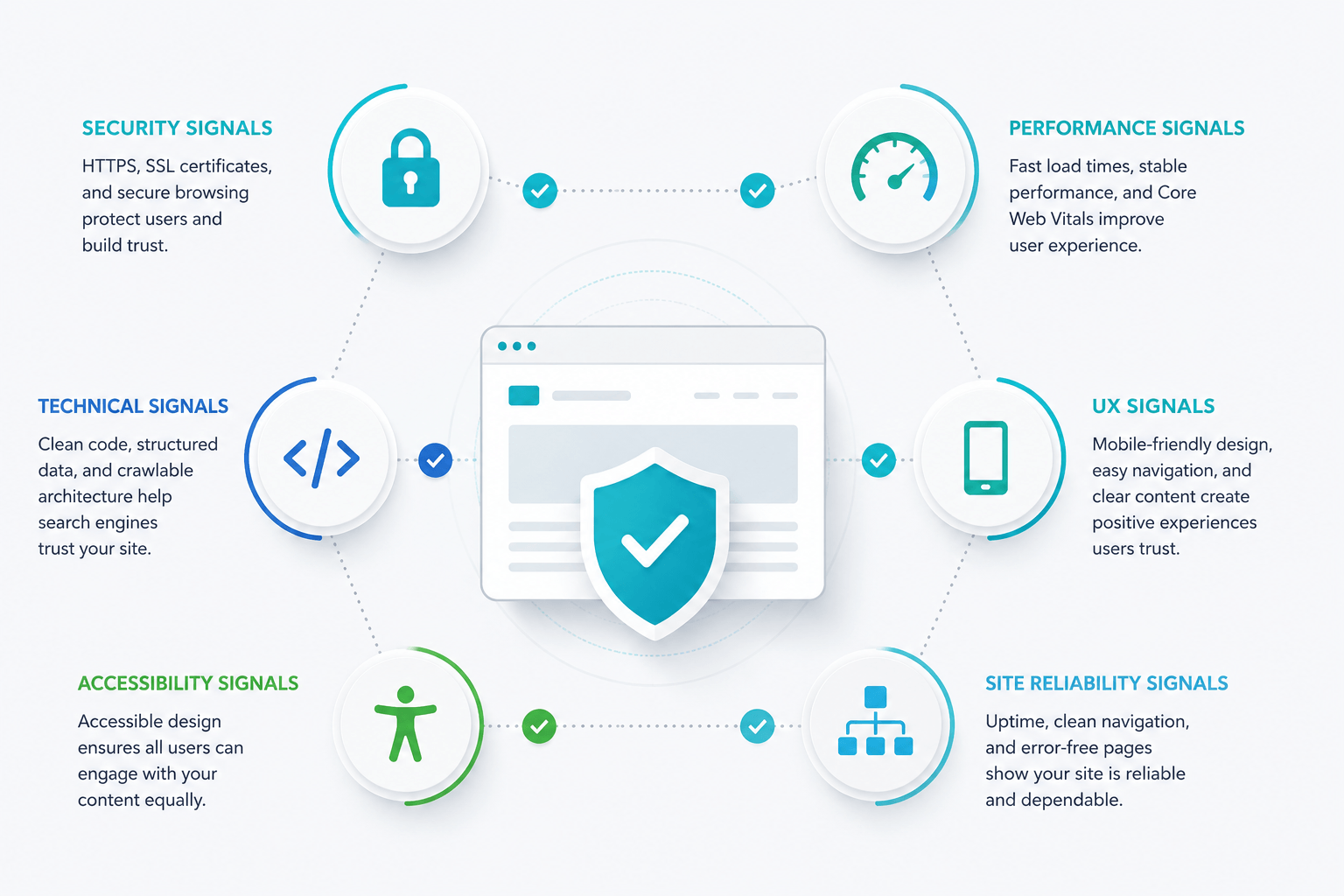
They answer the question: “Can I trust this experience?”
These are often overlooked because they are more technical, but they still play a role in both rankings and conversions.
Key examples include:
- HTTPS (secure website)
- Fast load times
- Mobile-friendly design
- Clear navigation and structure
- No broken links or errors
- Accessible, easy-to-read content
Google considers page experience as part of its ranking systems, especially when multiple pages offer similar relevance.
Reliability also impacts how users behave on your site. A slow or confusing experience can reduce trust instantly, regardless of how strong your content is.
How These Work Together
The real impact comes from combining all four types.
- Identity builds clarity
- Proof builds confidence
- Reputation builds authority
- Reliability builds consistency
If one area is missing, trust weakens.
If all four are strong, your site becomes:
- Easier to rank
- More likely to earn clicks
- More likely to convert
- More likely to be included in AI-generated answers
On-Page Trust Signals to Build First
If you are improving trust signals, start with your own website.
On-page signals are the easiest to control and often the fastest to impact both SEO performance and conversions.
These are the elements users and search engines evaluate immediately when they land on your site.
About Page, Contact Details, and Service Areas
Your website should clearly show who you are, where you operate, and how to reach you.
This sounds basic, but many sites either hide this information or keep it too vague.
Make sure you have:
- A detailed About page (not just a short paragraph)
- A visible phone number and email
- A physical address or clearly defined service area
- Consistent business information across all pages
This directly supports how search engines evaluate legitimacy.
Google uses signals like consistency of business information, links, and reviews to determine prominence, especially in local search. When your identity is clear and consistent, it strengthens your overall credibility.
For users, this removes friction. If someone cannot quickly figure out who you are or how to contact you, trust drops immediately.
Author Bios and Expert Attribution
Content without a clear author is harder to trust.
This is especially important for:
- Blog content
- Service pages
- Educational resources
Adding author attribution helps establish expertise and accountability.
Best practices:
- Include the author’s full name
- Add a short bio with relevant experience
- Link to a profile page when possible
- Keep author information consistent across content
Structured data can also reinforce this. Google recommends using Article schema and including author details to help better understand who created the content.
For AI visibility, this becomes even more important.
Clear authorship helps systems connect your content to a real person or entity, which increases the likelihood of being trusted and referenced.
Case Studies, Real Examples, and Original Photos
Most websites say the same things:
- “We deliver results”
- “We are experts”
- “We provide high-quality service”
Very few prove it.
This is where proof signals become a competitive advantage.
Strong on-page proof includes:
- Case studies with clear outcomes
- Before-and-after visuals
- Project breakdowns
- Real photos from your work
- Specific metrics (when possible)
This type of content does more than build trust. It differentiates your site from competitors using generic messaging.
It also aligns with how search and AI systems evaluate content.
Specific, detailed information is easier to validate, compare, and surface than broad claims.
Reviews, Testimonials, and Social Proof
Social proof is one of the fastest ways to build trust.
Users rely heavily on what others say, especially when choosing a service provider.
Include:
- Customer testimonials on key pages
- Embedded or pulled-in Google reviews
- Star ratings where appropriate
- Quotes tied to real clients (not anonymous)
Google has stated that review quantity and quality can influence visibility, particularly in local search².
Beyond SEO, this directly impacts conversions.
A strong review presence can be the difference between a user clicking your site or choosing a competitor.
FAQs, Policies, and Transparency Elements
Transparency signals reduce uncertainty.
They show that your business is open, clear, and accountable.
Important elements include:
- FAQ sections that answer real customer questions
- Service explanations (what is included, what is not)
- Pricing guidance (even if ranges)
- Privacy policies and terms
- Guarantees or warranties
These signals help both users and search engines.
For users, they remove doubt.
For search engines and AI systems, they provide structured, easy-to-understand information that can be surfaced in answers.
This is also where formatting matters.
Well-structured FAQs, lists, and short answers increase the chances of appearing in featured snippets and AI-generated responses.
Quick Checklist: On-Page Trust Signals
| Area | What to Check |
| Identity | About + contact info visible |
| Proof | Case studies or real examples |
| Reputation | Reviews/testimonials present |
| Reliability | Clear structure + fast pages |
Off-Page Trust Signals That Strengthen SEO Authority
On-page signals build your foundation.
Off-page signals validate your business externally.
They show search engines and AI systems that your credibility is not just self-claimed — it is recognized across the web.
Quality Backlinks
Backlinks remain one of the strongest trust and authority signals in SEO.
But not all links are equal.
Search engines evaluate:
- Relevance of the linking site
- Authority of the domain
- Context of the link
- Natural placement within content
A few high-quality, relevant backlinks will outperform dozens of low-quality ones.
Recent studies also show that stronger backlink authority is associated with higher visibility across AI search platforms³.
Focus on:
- Industry-relevant websites
- Editorial placements (not directories or spam links)
- Earning links through useful, original content
Brand Mentions and Citations
Links are not the only signal that matters.
Search engines also evaluate brand mentions, even when they are not linked.
These include:
- Mentions of your business name in articles
- Listings in directories
- Industry citations
- Local business references
These signals help reinforce:
- Brand recognition
- Entity consistency
- Overall credibility
Reviews and Reputation Across Platforms
Your reputation does not live only on your website.
Search engines evaluate reviews across platforms like:
- Yelp
- Industry-specific directories
- Third-party review sites
Strong review signals include:
- High average rating
- Consistent review volume over time
- Recent reviews
- Responses from the business
These signals do more than improve rankings.
They influence:
- Click-through rates
- Conversion decisions
- Overall brand perception
A business with strong reviews stands out immediately in search results.
Consistent Business Information (NAP)
NAP stands for:
- Name
- Address
- Phone number
This information should be consistent across:
- Your website
- Google Business Profile
- Directories and listings
- Social profiles
Inconsistent information creates confusion.
For search engines, it weakens trust.
For users, it creates doubt.
Consistency helps:
- Strengthen local SEO signals
- Improve entity recognition
- Reinforce legitimacy
This is one of the simplest trust signals to fix, yet one of the most commonly overlooked.
Quick Comparison: Strong vs Weak Off-Page Signals
| Strong Signals | Weak Signals |
| Relevant, authoritative links | Spammy or irrelevant links |
| Consistent brand mentions | Inconsistent citations |
| High-quality reviews | Few or negative reviews |
| Verified listings | Missing or outdated info |
Why Off-Page Signals Matter for AI Visibility
AI systems do not rely on a single source.
They look for corroboration across multiple sources.
If your business:
- Has strong backlinks
- Is mentioned across trusted sites
- Maintains consistent information
- Has a solid review presence
…it becomes significantly easier for AI systems to:
- Recognize your brand
- Validate your credibility
- Include you in generated answers
This is where many businesses lose visibility.
They optimize their website but ignore their presence across the rest of the web.
How Trust Signals Improve AI Visibility
AI search is changing how visibility works.
Instead of ranking a list of pages, AI systems:
- Pull information from multiple sources
- Evaluate credibility across those sources
- Generate a single, combined answer
This changes what it takes to show up.
It is no longer just about ranking well.
It is about being trusted enough to be included.
Why Clear Identity and Entities Matter
AI systems need to understand who you are.
That includes:
- Your business name
- Your services
- Your location
- Your authors or experts
If this information is unclear or inconsistent, it becomes harder to:
- Connect your content to a real entity
- Validate your credibility
- Include your brand in answers
This is why identity signals matter beyond your website.
Consistency across your:
- Website
- Business listings
- Mentions across the web
…makes it easier for AI systems to recognize and trust your brand.
Why Structured, Clear Content Gets Used
AI systems do not read content the way humans do.
They look for information that is:
- Easy to extract
- Clearly structured
- Directly answers questions
This is where formatting plays a role.
Content that uses:
- Clear headings
- Short, direct explanations
- Lists and bullet points
- FAQs and concise answers
…is easier to surface in AI-generated responses.
This is also why generic, long-form content without structure often underperforms.
Even if it ranks, it is harder to extract and reuse.
Why Corroboration Across the Web Matters
AI systems rely on multiple sources to validate information¹.
They are not just looking at your website.
They are comparing it to:
- Other websites
- Reviews
- Mentions
- Industry sources
If your business shows up consistently across these sources, it strengthens trust.
If your information is:
- Incomplete
- Inconsistent
- Missing from key platforms
…it becomes harder to validate.
This is one of the biggest differences between traditional SEO and AI visibility.
Ranking is influenced by your page.
AI visibility is influenced by your entire presence across the web.
The Key Shift
To perform well in AI search, your content needs to be:
- Clear enough to extract
- Credible enough to trust
- Consistent enough to verify
Trust signals are what make that possible.
They connect your:
- Website content
- Business identity
- External reputation
…into a single, verifiable presence.
Quick Summary
| Factor | Why It Matters for AI Visibility |
| Identity | Helps systems recognize your brand |
| Structure | Makes content easier to extract |
| Consistency | Enables validation across sources |
| Reputation | Reinforces credibility |
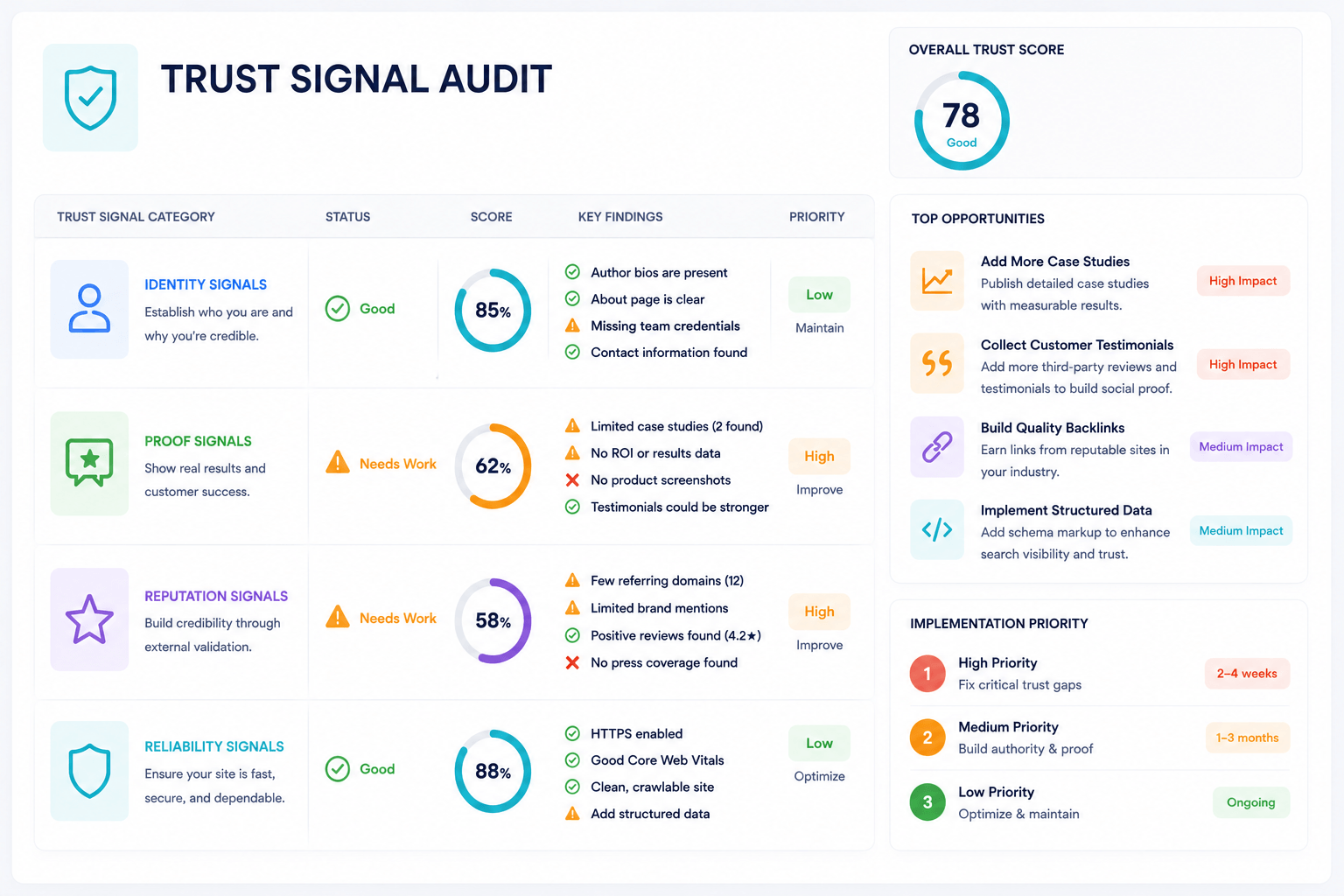
A Practical Trust Signal Audit
Most websites are not missing everything.
They are missing a few key signals that weaken everything else.
This quick audit helps you identify where trust is breaking down and what to fix first.
What to Fix This Month (Quick Wins)
Start with the signals you can control immediately.
These typically require minimal effort but have a strong impact on both trust and conversions.
Focus on:
- Adding or expanding your About page
- Making contact information clearly visible
- Embedding reviews or testimonials on key pages
- Adding author names and basic bios to content
- Fixing inconsistent business information across listings
These changes improve:
- First impressions
- User confidence
- Baseline SEO trust signals
They also remove common friction points that cause users to leave.
What to Build Next Quarter (Stronger Signals)
Once the basics are in place, shift to building deeper trust signals that take more time but create a competitive advantage.
Focus on:
- Creating detailed case studies with real outcomes
- Adding before-and-after visuals or project examples
- Earning high-quality backlinks from relevant sites
- Building consistent review generation processes
- Expanding service pages with real-world proof
This is where most businesses start to separate from competitors.
Instead of just saying they are good, they show it clearly and consistently
What to Measure
Trust signals are not just visual improvements. They directly impact performance.
Track:
- Click-through rate (CTR) from search results
- Conversion rates on key pages
- Time on page and engagement metrics
- Review volume and average rating
- Growth in branded searches
These metrics help you understand:
- Whether users trust your site enough to click
- Whether they trust you enough to convert
- Whether your reputation is improving over time
Simple Self-Assessment
Use this quick check to identify gaps:
| Area | Question |
| Identity | Is it clear who owns this site? |
| Proof | Do we show real results? |
| Reputation | Do we have strong external validation? |
| Reliability | Is the site fast, clear, and easy to use? |
If you answer “no” to any of these, that is where you should focus first.
The Goal of the Audit
You are not trying to “add more content.”
You are trying to:
- Make your business easier to trust
- Make your content easier to validate
- Make your presence more consistent
Small improvements here compound quickly.
A few strong trust signals can outperform a large amount of generic content.
How SEO Services Help Build Trust Signals at Scale
Building trust signals is not a one-time task.
It is an ongoing process that requires:
- Consistency
- Strategy
- Execution across multiple channels
This is where most businesses struggle.
They might add a few elements like reviews or an About page, but they do not build a complete, aligned trust signal system.
Why Most Businesses Fall Short
The challenge is not knowing what trust signals are.
It is:
- Not knowing which ones matter most
- Not prioritizing them correctly
- Not maintaining them over time
For example:
- A business may have strong reviews but weak content
- Or strong content but no backlinks
- Or consistent branding but no real proof of results
When signals are incomplete or disconnected, trust weakens.
And when trust weakens, performance follows.
What a Structured SEO Approach Looks Like
A strong SEO strategy does not treat trust signals as separate tasks.
It builds them into every part of your marketing.
That includes:
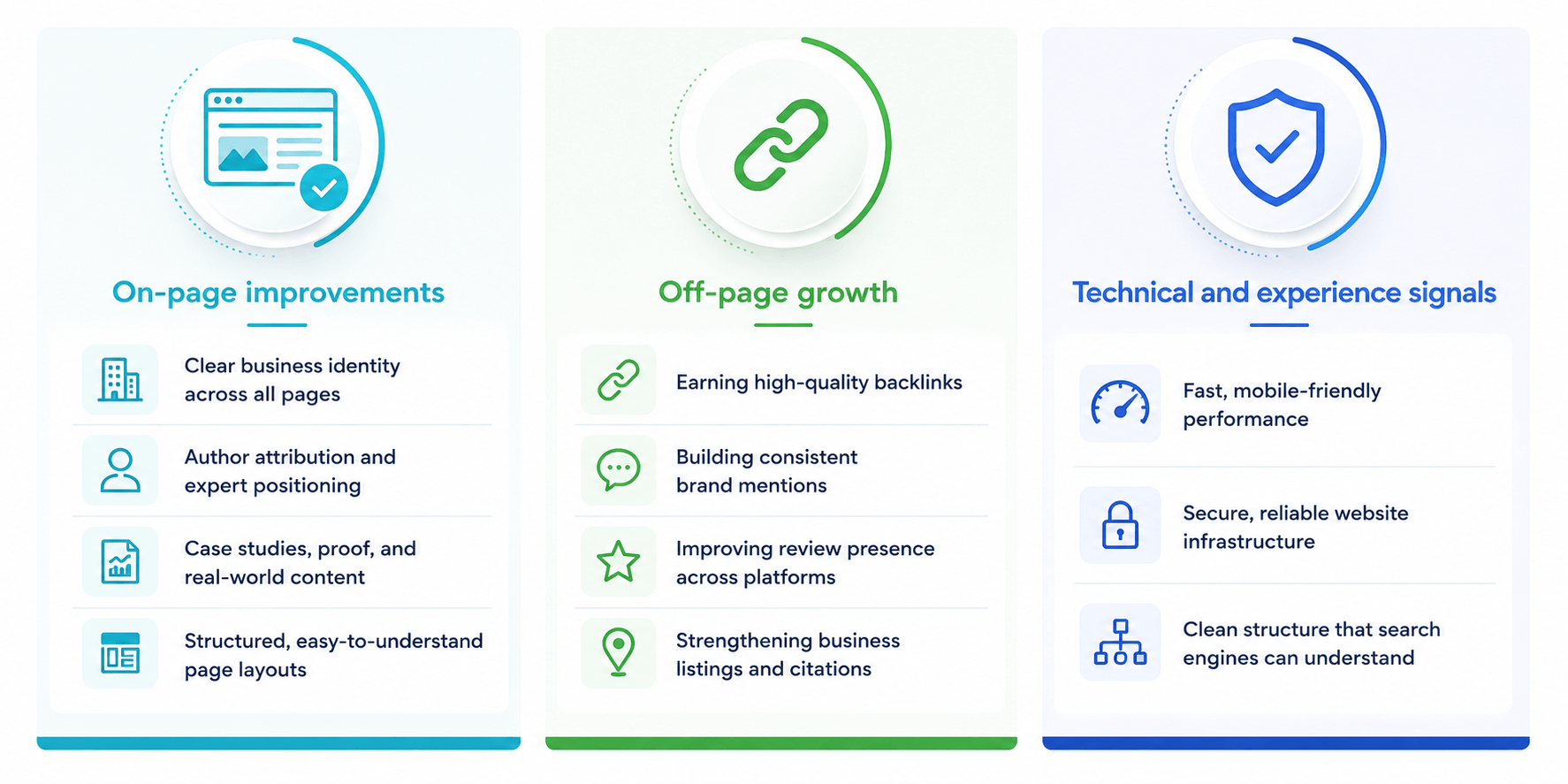
This creates a system where every signal reinforces the others.
Why This Matters for SEO and AI Visibility
When trust signals are built correctly, they compound.
Your site becomes:
- Easier to rank in competitive search results
- More likely to earn clicks and conversions
- More recognizable across the web
- More likely to be surfaced in AI-generated answers
Instead of relying on one factor, you build multiple layers of validation.
That is what modern search is looking for.
The Difference Between Activity and Strategy
Many businesses invest in SEO activities:
- Publishing content
- Building links
- Asking for reviews
But without a clear strategy, these efforts stay disconnected.
A structured approach aligns everything toward one goal:
Making your business easier to trust at every touchpoint.
That is what drives long-term growth.
Where This Fits Into Your Growth Strategy
Trust signals are not just an SEO tactic.
They impact:
- How users perceive your brand
- How easily you convert traffic
- How consistently you generate leads
When done right, they turn SEO from a traffic channel into a revenue driver.
FAQ: Trust Signals for SEO
What are trust signals in SEO?
Trust signals are elements that show your website and business are credible, legitimate, and reliable.
These include:
- Reviews and testimonials
- Backlinks from other websites
- Clear business information
- Author bios and expert attribution
- Case studies and real-world proof
They help search engines evaluate credibility, help users decide whether to engage, and help AI systems determine whether your content is worth including in answers.
Do trust signals directly affect rankings?
Trust signals are not a single ranking factor, but they influence many of the signals search engines use.
For example:
- Backlinks impact authority
- Reviews influence local visibility
- Content quality and authorship support credibility
- Page experience affects usability
Together, these signals strengthen your ability to rank consistently, especially in competitive searches.
Which trust signals matter the most?
The most impactful trust signals typically fall into four categories:
- Identity ? clear business and author information
- Proof ? case studies, real results, original content
- Reputation ? reviews, backlinks, brand mentions
- Reliability ? site performance, structure, security
Most high-performing websites have strong signals in all four areas, not just one.
How do trust signals impact AI search results?
AI systems do not rely on a single page.
They evaluate credibility across multiple sources and prioritize content that is:
- Clear and structured
- Consistent across the web
- Supported by strong reputation signals
If your business has strong trust signals, it becomes easier for AI systems to:
- Recognize your brand
- Validate your content
- Include you in generated answers
Can I improve trust signals without building backlinks?
Yes — you can strengthen trust signals without focusing only on backlinks.
Start with:
- Improving your About page and contact information
- Adding reviews and testimonials
- Publishing case studies and real examples
- Adding author attribution to your content
Backlinks are still important, but they are only one part of a larger system.
How long does it take to see results from trust signals?
Some improvements can have an immediate impact, while others take time.
Short-term improvements:
- Better conversions from adding reviews and proof
- Improved user engagement
Long-term improvements:
- Stronger rankings from backlinks and reputation
- Increased visibility across search and AI platforms
Trust builds over time, but small changes can start improving performance quickly.
Do I need structured data to build trust?
Structured data is not required, but it helps search engines better understand your content.
It can support:
- Author identification
- Business information
- Content context
When combined with strong on-page and off-page signals, it improves clarity and reinforces trust.
Final Takeaway
Trust signals are not one element you add to a page.
They are built through consistent, verifiable signals across your website and the web.
When done right, they improve:
- Rankings
- Click-through rates
- Conversions
- AI visibility
And that is what turns SEO into a reliable source of growth.
Not Sure Where to Start?
Building trust signals sounds straightforward. In reality, it is one of the most overlooked and mismanaged parts of SEO.
Most businesses know they need:
- Better content
- More reviews
- Stronger visibility
But they are not sure:
- Which trust signals actually matter
- Where their biggest gaps are
- How to prioritize what will move the needle
That is where having the right partner makes a difference.
At Digital Division, we do not just execute tactics. We work alongside your team to:
- Identify where trust is breaking down
- Align your SEO, content, and brand presence
- Build a clear strategy focused on real growth
In many cases, we act as a fractional marketing partner, helping guide decisions, prioritize efforts, and ensure everything works together, not in silos.
Whether you need strategy, execution, or both, the goal is the same:
Make your business easier to trust, easier to find, and easier to choose.
Ready to Strengthen Your SEO and Brand Trust?
If you are unsure where to start, we can help you map it out.
Reach out for a consultation and we will walk through:
- Where your current trust signals stand
- What is holding back your SEO performance
- What to prioritize next for measurable impact
Start with a conversation. Build from there.
Sources
- Google Search Central — AI features and search fundamentals
https://developers.google.com/search/docs/appearance/ai-features - Google Business Profile Help — How local ranking works
https://support.google.com/business/answer/7091 - Semrush — Backlinks and AI search visibility study
https://www.semrush.com/blog/backlinks-ai-search-study/
DIGITAL MARKETING SOLUTIONS
Relax.
You've got a digital marketing partner.
Digital Division is a marketing agency with solutions that can help you generate leads and transform your business.