

How Fractional CMO Support Helps Product Launches Gain Traction
Published July 8, 2026
A product launch can look organized on the surface. The product is ready. The deadline is set. The team has a checklist. Maybe there’s a landing page, an email campaign, a few social posts, and a paid media budget waiting to go live.
But that does not always mean the launch is strategically ready.
The real challenge is not simply getting the product into the market. It is making sure the right audience understands it, the message is clear, the sales team knows how to talk about it, and every marketing channel is working toward the same goal.
That is where fractional CMO support for product launches can make a meaningful difference.
A fractional CMO brings senior-level marketing leadership into the launch process without requiring a full-time executive hire. Instead of treating the launch as a collection of marketing tasks, they help connect the strategy, positioning, campaigns, sales alignment, and performance metrics behind it.
For companies preparing to launch a new product, service, feature, or market expansion, this kind of leadership can help turn scattered activity into a focused go-to-market plan.
And when that strategy is backed by a team that can execute, the launch has a stronger chance of gaining traction.
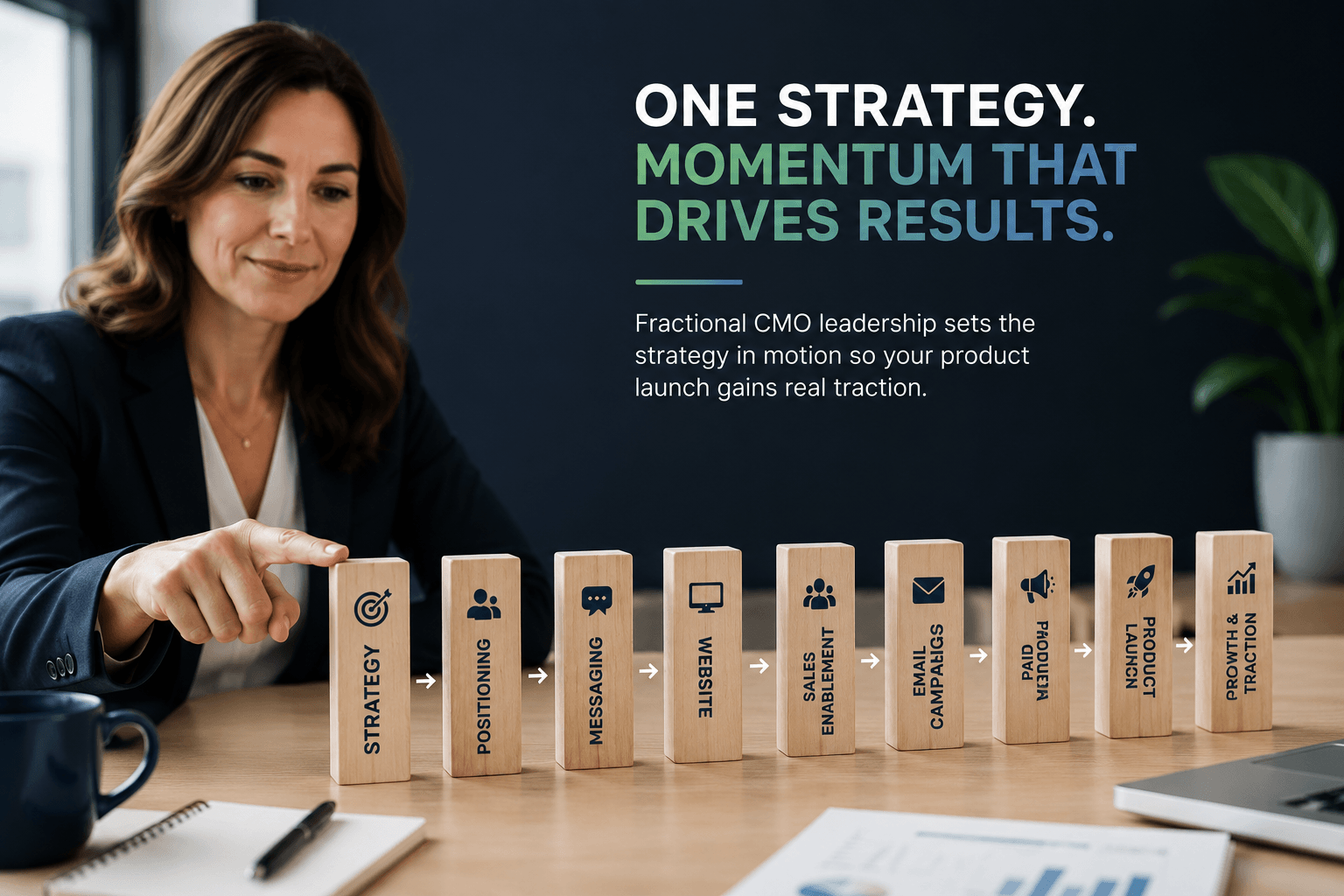
Product Launches Need More Than a Marketing Checklist
A launch checklist is useful. It helps teams stay organized, assign tasks, and avoid missing important details.
But a checklist cannot answer the bigger questions that determine whether the launch will actually perform.
Who is this product really for?
What problem does it solve better than the alternatives?
Why should the audience care now?
Which channels deserve the most attention?
How will sales and marketing work together after the campaign goes live?
These are strategic questions. And if they are not answered early, even a well-executed launch can feel disconnected.
A business may have all the visible pieces in place, but still struggle because:
- The target audience is too broad.
- The product message sounds different across teams.
- The website does not clearly explain the value.
- Paid media sends traffic to a weak conversion path.
- Sales does not have the right talking points or follow-up process.
- Leadership is not sure which metrics actually define success.
This is why product launch marketing strategy needs more than activity. It needs direction.
A fractional CMO helps bring that direction into the process. They look at the launch from a leadership perspective, not just a channel perspective. That means they are not only asking, “What assets do we need?” They are asking, “What needs to happen for this launch to support growth?”
That shift matters.
Because a successful launch is not about being everywhere. It is about showing up in the right places, with the right message, for the right audience, with a clear path to action.
What Does a Fractional CMO Do During a Product Launch?
A fractional CMO does not just “help with marketing.”
They give the launch a strategic marketing leader.
That matters because most product launches do not fail due to a lack of activity.
They struggle because the strategy behind the activity is unclear.
The audience is too broad.
The positioning is weak.
The website does not support conversions.
Sales and marketing are not aligned.
Campaigns launch without a clear growth goal.
A fractional CMO helps solve those problems before they slow down the launch.
Instead of asking:
“What marketing assets do we need?”
They ask:
“What needs to happen for this launch to generate traction, leads, and revenue?”
That shift changes everything.
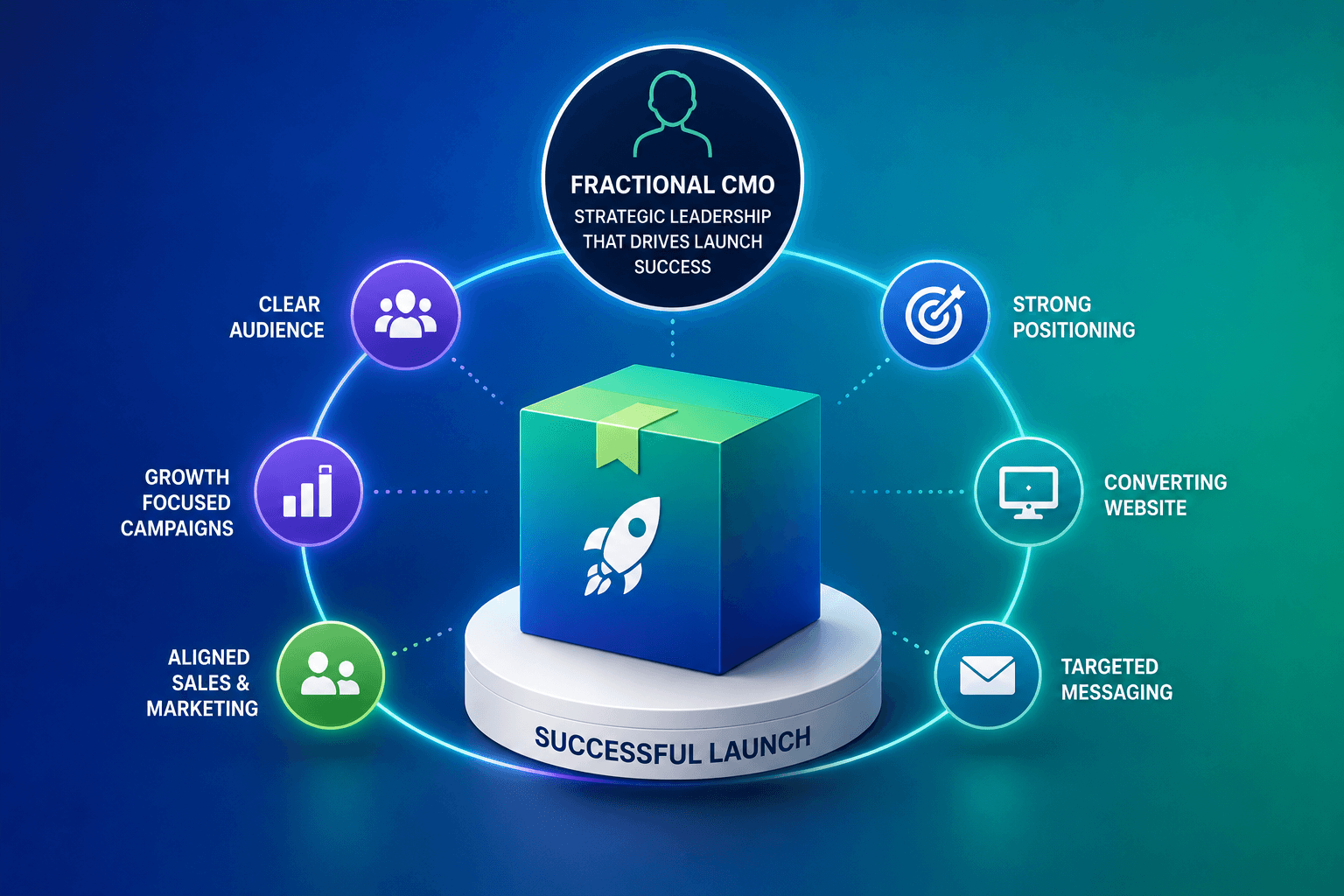
A Fractional CMO Connects the Entire Launch Strategy
One of the biggest launch problems is fragmentation.
Product is focused on features.
Marketing is focused on campaigns.
Sales is focused on pipeline.
Leadership is focused on growth.
But nobody is connecting the full picture.
A fractional CMO helps bring those moving pieces together into one go-to-market strategy.
That can include:
- Audience targeting
- Positioning and messaging
- Website strategy
- SEO and demand capture
- Paid media planning
- Sales enablement
- Launch KPIs
- Reporting and optimization
The goal is not to make the launch more complicated.
The goal is to make it more focused.
| Without strategic leadership | With fractional CMO support |
| Random launch tasks | Clear go-to-market strategy |
| Channel-first decisions | Audience-first decisions |
| Generic messaging | Strong positioning |
| Disconnected campaigns | Unified marketing direction |
This is one reason the fractional CMO model has become more valuable for growing businesses.
Companies do not always need a full-time marketing executive.
But they often need experienced leadership during high-impact moments like a product launch.
A Fractional CMO Helps Prioritize What Actually Matters
One of the easiest ways to waste a launch budget is trying to do everything at once.
Every platform.
Every campaign type.
Every marketing trend.
That usually creates more noise than traction.
A fractional CMO helps identify:
- Which channels deserve investment
- What messaging should lead the launch
- Which audience segments matter most
- What should happen before vs. after launch
- How marketing should support sales conversations
This is especially important when internal teams are stretched thin.
Because launch success is not about being everywhere.
It is about showing up in the right places with the right message.
Strategy Without Execution Is Still a Problem
Some businesses already have strong ideas and internal direction.
What they lack is execution support.
Others have execution teams running campaigns, but no senior-level marketing leadership guiding the strategy.
Digital Division’s positioning sits between those two gaps.
Many fractional CMOs provide strategy only.
Many agencies provide execution only.
Digital Division combines both.
That means businesses can get:
- Strategic launch guidance
- Marketing leadership
- Channel prioritization
- Messaging support
- Campaign execution
- Performance reporting
- Ongoing optimization
All within the same growth system.
And during a product launch, that alignment matters.
Because a launch performs best when strategy, messaging, execution, and measurement are all working toward the same outcome.
Where Fractional CMO Support Fits Before, During, and After Launch
Most product launches focus heavily on the launch date itself.
But successful launches are usually won before the campaign goes live and improved long after the announcement happens.
That is why strong fractional CMO support during a product launch is not limited to one campaign or one week of activity.
It supports the full go-to-market strategy behind the launch.
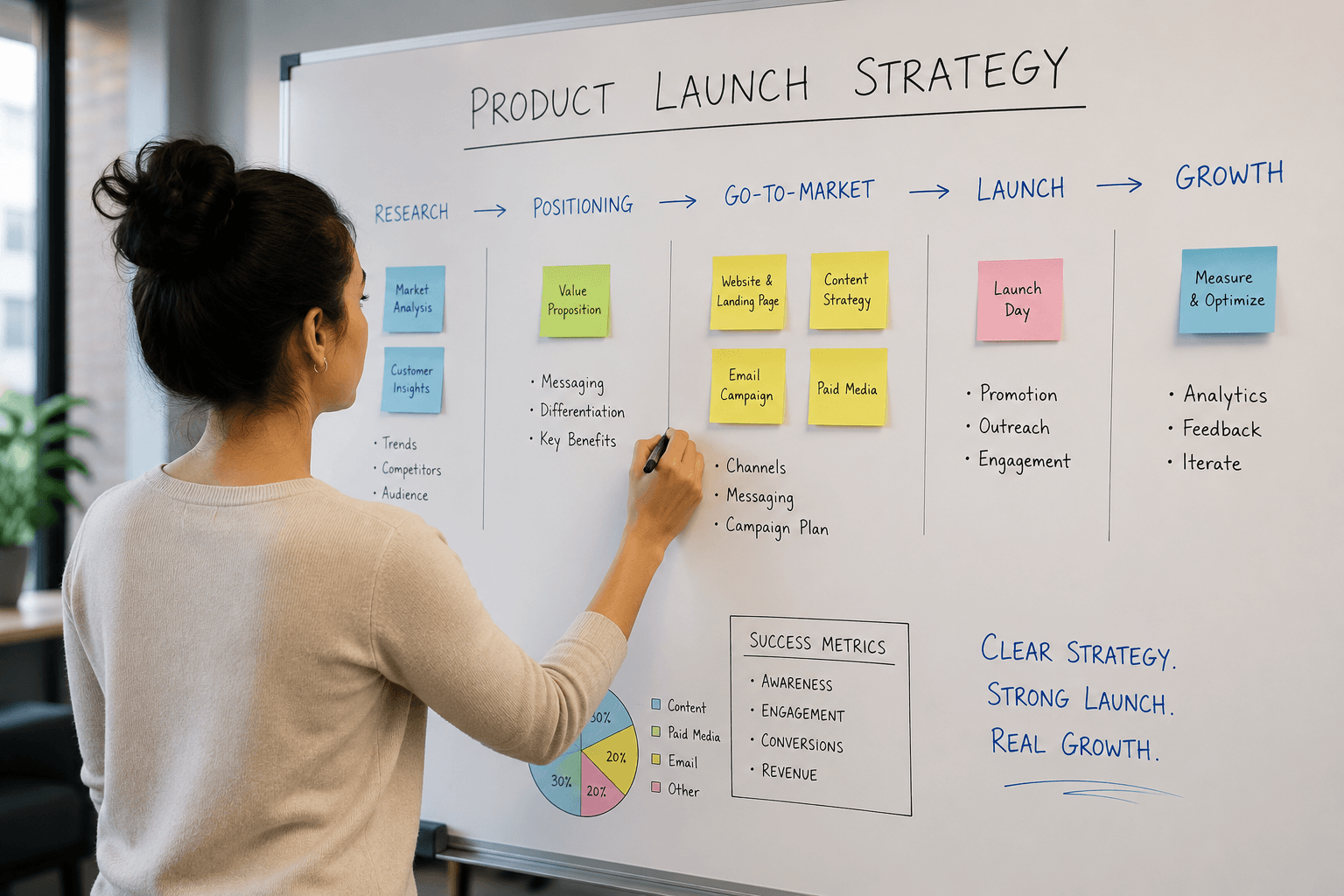
Before Launch: Build the Strategy First
This is where many launches either gain momentum or create future problems.
Teams often jump straight into execution:
- Designing landing pages
- Building ads
- Writing emails
- Scheduling social content
But without a clear strategy behind those assets, the launch can feel disconnected fast.
Before launch, a fractional CMO helps define the foundation.
That usually includes:
- Audience targeting
- Market positioning
- Core messaging
- Offer clarity
- Channel prioritization
- Launch goals and KPIs
- Website and conversion strategy
This stage is critical because every marketing decision becomes easier once positioning and messaging are clear.
A strong launch strategy also helps prevent wasted spend.
Instead of trying to market to everyone, the focus becomes:
“Who is most likely to care about this launch, and what message will move them to act?”
That clarity improves everything downstream, including SEO, paid media, website conversions, and sales conversations.
During Launch: Align Marketing, Sales, and Execution
Once the launch goes live, speed matters.
But alignment matters even more.
This is where many businesses struggle.
Marketing is generating traffic.
Sales is handling leads differently.
Leadership wants reporting.
The website is missing key information.
Paid campaigns are spending budget too quickly.
A fractional CMO helps keep the launch coordinated while the campaign is active.
That can include:
- Monitoring campaign performance
- Adjusting messaging
- Prioritizing channels
- Improving conversion paths
- Supporting sales enablement
- Identifying performance gaps quickly
The goal is not to react emotionally to every number.
It is to understand what the data is actually saying.
For example:
| Launch issue | Strategic adjustment |
| Traffic is high, conversions are low | Improve messaging or landing page clarity |
| PPC spend is rising too fast | Reallocate budget to higher-performing channels |
| Leads are not qualified | Refine audience targeting |
| Sales calls are inconsistent | Improve sales enablement materials |
This is one reason strategic marketing leadership matters during launches.
Someone needs to step back, evaluate performance objectively, and make decisions based on growth priorities, not panic.
After Launch: Optimize What the Market Is Telling You
Many companies treat launch day like the finish line.
In reality, it is usually the beginning of the learning phase.
Once real users interact with the product, valuable patterns start to appear:
- Which messaging resonates
- Which channels drive the best leads
- Which objections show up repeatedly
- Which audience segments convert fastest
- Where the sales process slows down
A fractional CMO helps turn that feedback into smarter marketing decisions.
That might include:
- Updating website messaging
- Refining paid media targeting
- Expanding SEO content opportunities
- Improving conversion funnels
- Adjusting positioning
- Scaling high-performing campaigns
This is where the launch starts evolving into a long-term growth strategy instead of a short-term campaign.
And that aligns closely with Digital Division’s Fractional CMO approach:
ongoing strategic guidance, measurable growth, and continuous marketing improvement.
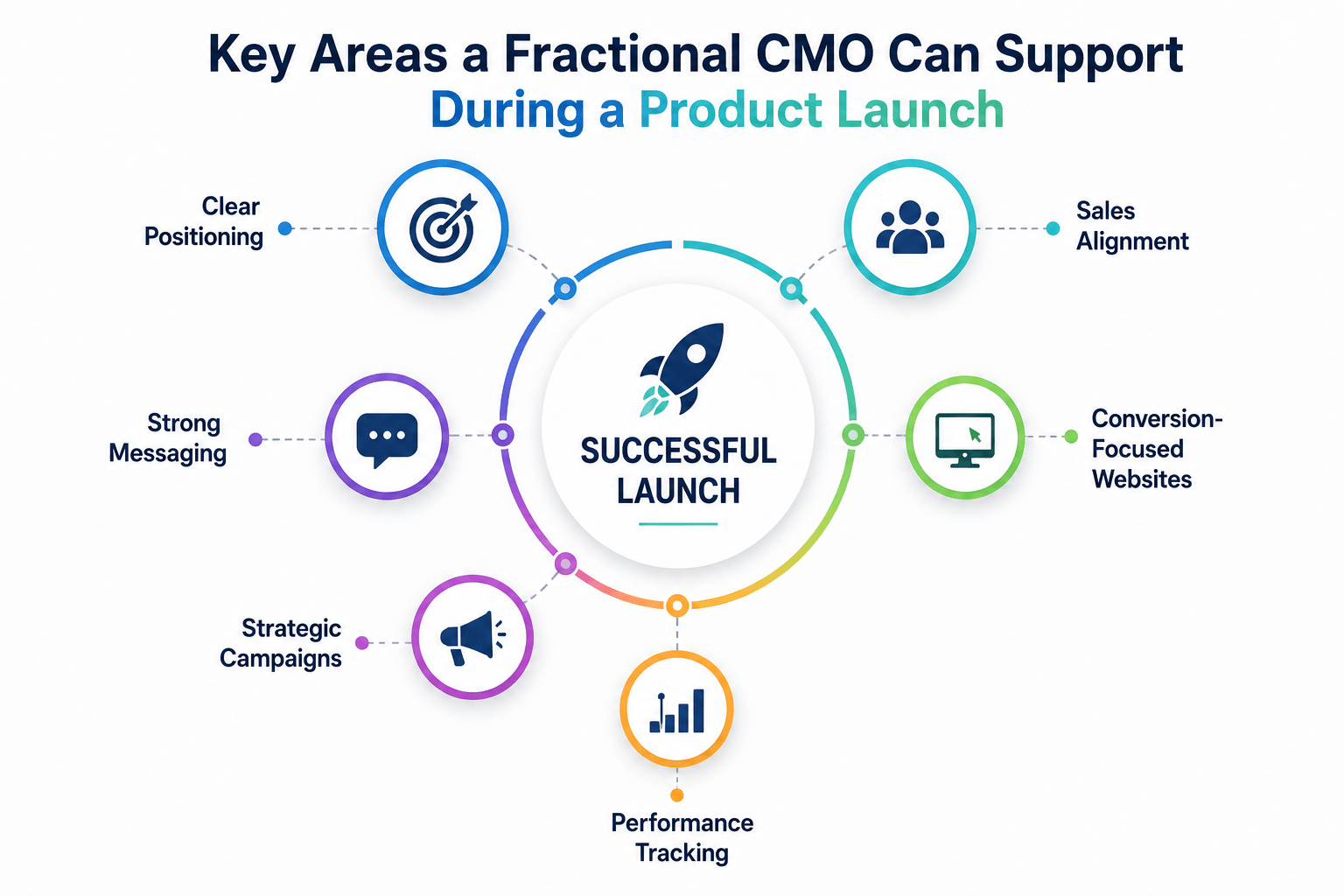
Key Areas a Fractional CMO Can Support During a Product Launch
A successful launch is rarely driven by one channel alone.
It is usually the result of multiple systems working together:
- Clear positioning
- Strong messaging
- Strategic campaigns
- Sales alignment
- Conversion-focused websites
- Performance tracking
That is why fractional CMO support often touches several areas of the business at once.
Not to create more complexity.
To create more alignment.
Audience and Market Clarity
One of the fastest ways to weaken a launch is trying to market to everyone.
When the audience is too broad, the messaging becomes generic. And generic messaging rarely creates traction.
A fractional CMO helps define:
- Who the launch is really for
- What pain points matter most
- What objections may slow conversions
- What differentiates the product from competitors
- Which audience segments are most valuable
That clarity shapes the entire go-to-market strategy.
Because strong launches are not built around features alone.
They are built around relevance.
Product Positioning and Messaging
A product can solve a real problem and still struggle if the messaging is unclear.
This is one reason positioning matters so much during a launch.
People need to quickly understand:
- What the product does
- Who it helps
- Why it matters
- Why it is different
- What action to take next
A fractional CMO helps translate product details into customer value.
That includes:
- Core messaging
- Value propositions
- Brand positioning
- Website copy direction
- Campaign messaging
- Sales talking points
And when positioning is clear, every marketing channel becomes more effective.
Channel and Campaign Strategy
Not every launch needs every channel.
Some launches need immediate demand generation through PPC.
Others benefit more from SEO, content, webinars, email, partnerships, or sales outreach.
A fractional CMO helps decide where the marketing investment should actually go.
Instead of asking:
“Which channels can we use?”
The better question becomes:
“Which channels are most likely to move the business forward right now?”
That strategic layer matters because every channel plays a different role.
| Channel | Strategic role |
| SEO | Capture long-term search demand |
| PPC | Generate immediate visibility |
| Content | Build trust and authority |
| Website | Convert attention into action |
This aligns closely with Digital Division’s positioning around SEO as demand capture, PPC as growth acceleration, and websites as conversion infrastructure.
Sales Enablement and Internal Alignment
Many launches focus heavily on marketing while overlooking the sales process behind it.
But if leads come in and the sales team is not aligned with the messaging, momentum can disappear quickly.
A fractional CMO helps bridge that gap.
That can include:
- Sales talking points
- Objection handling
- Follow-up strategy
- Website conversion paths
- Lead qualification discussions
- CRM and reporting alignment
This creates consistency between what the marketing promises and what the sales experience delivers.
And that consistency builds trust faster.
Launch KPIs and Performance Reporting
A launch should not be measured by activity alone.
Traffic, impressions, and clicks only matter if they support business outcomes.
A fractional CMO helps define which metrics actually matter for the launch goals.
That might include:
- Qualified leads
- Demo requests
- Pipeline growth
- Revenue impact
- Customer acquisition cost
- Conversion rates
- Product adoption
- Retention signals
This prevents teams from chasing vanity metrics that look impressive but do not support growth.
Because the goal of a launch is not simply visibility.
The goal is measurable business impact.
How Digital Division Supports Product Launches With Fractional CMO Leadership
Product launches create pressure fast.
Teams are balancing deadlines, messaging, campaigns, website updates, sales preparation, reporting, and performance expectations all at once.
And without clear strategic leadership, even strong products can struggle to gain traction.
Digital Division’s Fractional CMO approach is designed to help businesses navigate that process with more clarity, alignment, and direction.
Instead of functioning as a traditional marketing vendor, Digital Division works as a strategic marketing leadership partner that helps guide growth decisions while supporting execution across the marketing ecosystem.
That includes helping businesses:
- Clarify positioning and messaging
- Align sales and marketing efforts
- Prioritize the right channels
- Build conversion-focused launch strategies
- Support SEO, PPC, content, and website execution
- Measure launch performance against real business goals
The goal is not simply to launch campaigns.
The goal is to build a launch strategy that supports measurable growth.
That is an important difference.
Many agencies focus only on execution.
Many fractional CMOs focus only on strategy.
Digital Division combines both.
So instead of handing a company a strategy deck and walking away, the team can help move the launch forward through:
- Search visibility and demand capture
- Paid media strategy and optimization
- Website conversion improvements
- Content development
- Reporting and performance analysis
- Ongoing marketing refinement
This creates stronger alignment between strategy and execution during one of the most important growth moments for a business.
Because successful launches are rarely driven by isolated tactics.
They are driven by clear direction, strong positioning, coordinated execution, and continuous optimization.
If your business is preparing for a product launch, the strategy behind the launch matters just as much as the execution.
Digital Division helps businesses approach launches with strategic marketing leadership backed by a team that can execute across SEO, paid media, websites, content, and reporting.
Instead of disconnected marketing activity, the focus becomes clear positioning, aligned campaigns, measurable growth, and long-term momentum.
If you need experienced marketing leadership for an upcoming launch without hiring a full-time executive, explore Digital Division’s fractional CMO services.
When Should You Bring in a Fractional CMO for a Product Launch?
Not every launch needs a full internal marketing department.
But many launches do need stronger strategic direction.
That is especially true when the stakes are higher:
- A major product release
- A new market expansion
- A new service line
- A rebrand tied to growth
- A revenue-focused launch with aggressive goals
In those situations, execution alone is usually not enough.
The business also needs someone thinking about the bigger picture:
- Is the positioning strong enough?
- Are we targeting the right audience?
- Does the website support conversions?
- Which channels deserve the budget?
- How should marketing and sales work together?
- What metrics actually define success?
That is where a fractional CMO for product launches becomes valuable.
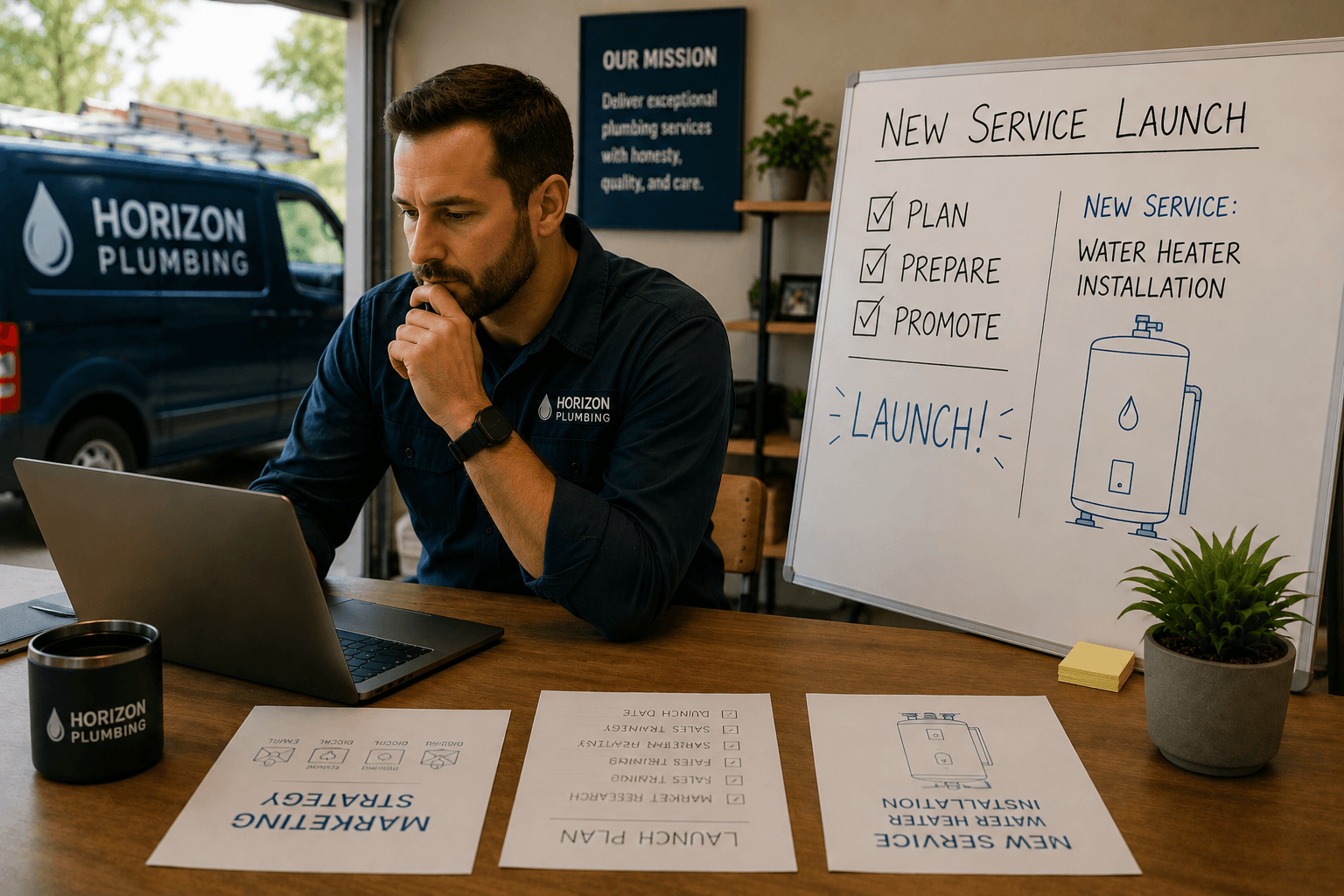
Signs Your Launch May Need Fractional CMO Support
A launch does not need to be failing before leadership support becomes useful.
In many cases, companies bring in a fractional CMO because they want to avoid expensive mistakes before the campaign goes live.
Here are some common signs:
- The internal team is stretched thin.
- Marketing execution exists, but strategy feels unclear.
- Leadership wants stronger ROI visibility.
- Sales and marketing are not aligned.
- The launch involves multiple channels and moving parts.
- The product is strong, but the messaging is inconsistent.
- The company is entering a competitive or unfamiliar market.
- Teams are unsure where to prioritize budget and effort.
One of the biggest advantages of fractional CMO support is perspective.
Internal teams are often deep in execution mode during launches.
A fractional CMO can step back, evaluate the launch strategically, and help prioritize what will actually drive growth.
You Do Not Always Need a Full-Time CMO
For many growing businesses, hiring a full-time CMO does not make sense yet.
The cost is high.
The long-term need may still be unclear.
And the business may not require executive-level marketing leadership year-round.
But during a product launch, experienced leadership can still have a major impact.
That is why the fractional CMO model continues to grow.
It gives businesses access to senior marketing strategy without requiring a permanent executive hire.
And when that strategic leadership is backed by an execution team, businesses gain both direction and momentum.
That combination is a major part of Digital Division’s positioning:
Strategy + Leadership + Execution.
Frequently Asked Questions About Fractional CMO Services
What does a fractional CMO do during a product launch?
A fractional CMO helps guide the strategic side of a product launch. This can include positioning, messaging, audience targeting, channel strategy, sales alignment, KPI planning, and marketing performance analysis. The goal is to ensure the launch supports measurable business growth rather than disconnected marketing activity.
When should a company hire a fractional CMO for a launch?
Businesses often bring in a fractional CMO when a launch has meaningful revenue goals, multiple moving parts, or limited internal strategic marketing leadership. This can be especially helpful for new product launches, market expansions, rebrands, or high-growth initiatives.
Is a fractional CMO better than hiring a marketing agency?
They serve different roles.
A marketing agency typically focuses on execution, such as SEO, paid media, content creation, or website development. A fractional CMO focuses on strategic leadership, helping determine what the business should prioritize and why.
Digital Division’s model combines both strategic guidance and execution support.
How does a fractional CMO work with product managers and sales teams?
A fractional CMO helps align the marketing strategy with the product and sales process. That can include refining messaging, supporting launch positioning, improving sales enablement, identifying conversion gaps, and helping teams stay aligned around shared growth goals.
DIGITAL MARKETING SOLUTIONS
Relax.
You've got a digital marketing partner.
Digital Division is a marketing agency with solutions that can help you generate leads and transform your business.