

Social Listening Techniques Agencies Use to Turn Conversations Into Strategy
Key Takeaways
- Social listening isn’t just monitoring. It helps you understand conversations and turn them into strategic decisions.
- Most conversations happen without you. Brands only drive about 1% of the discussion, making listening essential.
- Agencies use it to guide strategy. From competitors to trends to content, it informs real marketing decisions.
- Social is now a search engine. People use it to research, compare, and make buying decisions.
- Insights only matter if you act on them. The value comes from applying them to content, ads, SEO, and CX.
- Tools and AI help—but strategy wins. Data alone isn’t enough; interpretation and action are what create impact.

Most brands think they understand what people are saying about them online.
They don’t.
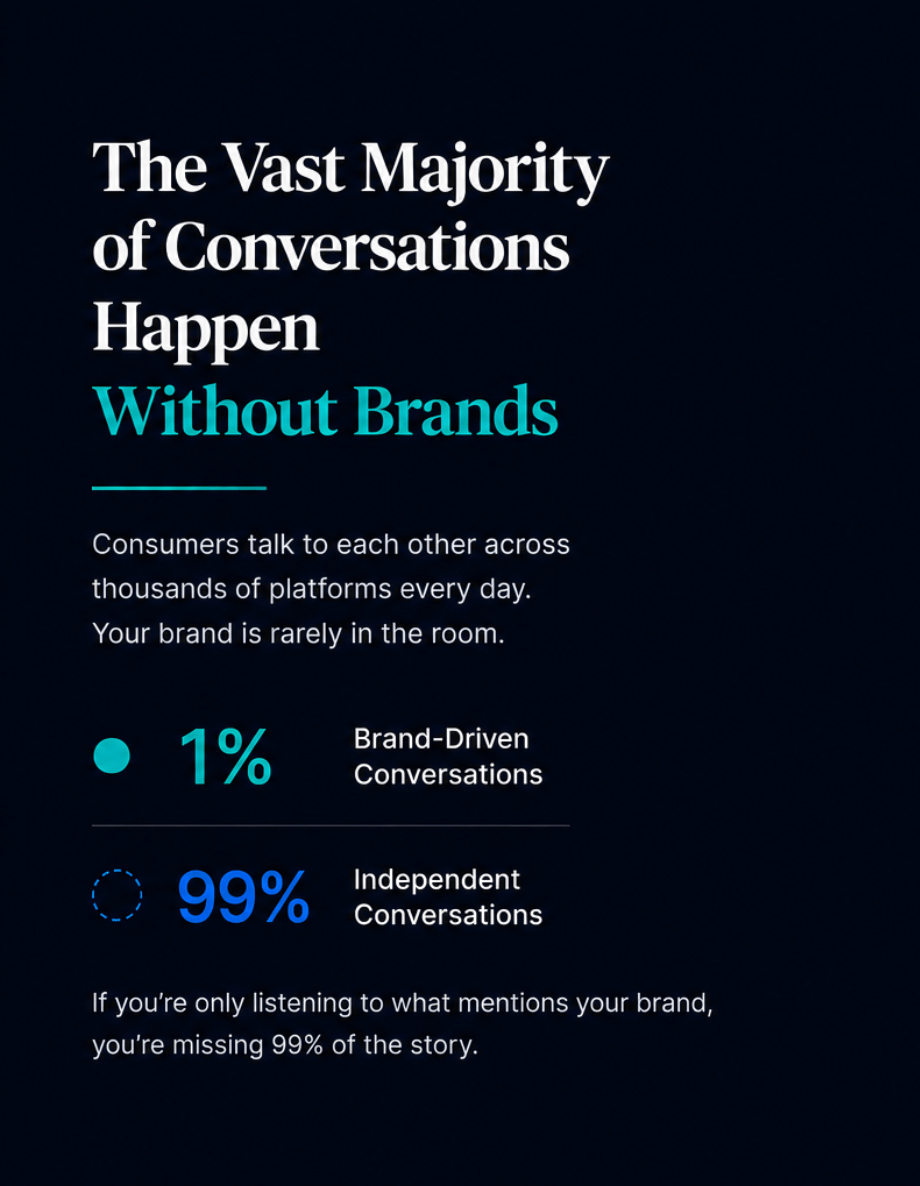
In reality, brands only drive about 1% of conversations about themselves on social media¹. The other 99% happens in comments, forums, reviews, and conversations they don’t control. That’s where real opinions are formed, trends emerge, and buying decisions start.
This is where social listening becomes critical.
But here’s the problem: most businesses treat social listening like a reporting tool. They track mentions, monitor tags, and measure engagement. That’s not wrong—but it’s not where the value is.
Agencies approach this differently.
Instead of just tracking what’s happening, they use social listening to understand why it’s happening—and what to do next. It becomes a system for uncovering customer insights, identifying trends early, analyzing competitors, and shaping strategy across marketing, content, and even product decisions.
That shift matters more than ever.
Today, social media is one of the primary ways people discover trends, research products, and form opinions about brands². It’s also fragmented across multiple platforms, with users actively participating in conversations that brands can’t afford to ignore³.
In this article, we’ll break down the social listening techniques agencies actually use—not just the basics, but the strategies that turn conversations into real business decisions.
What Is Social Listening (And Why It’s Different From Monitoring)
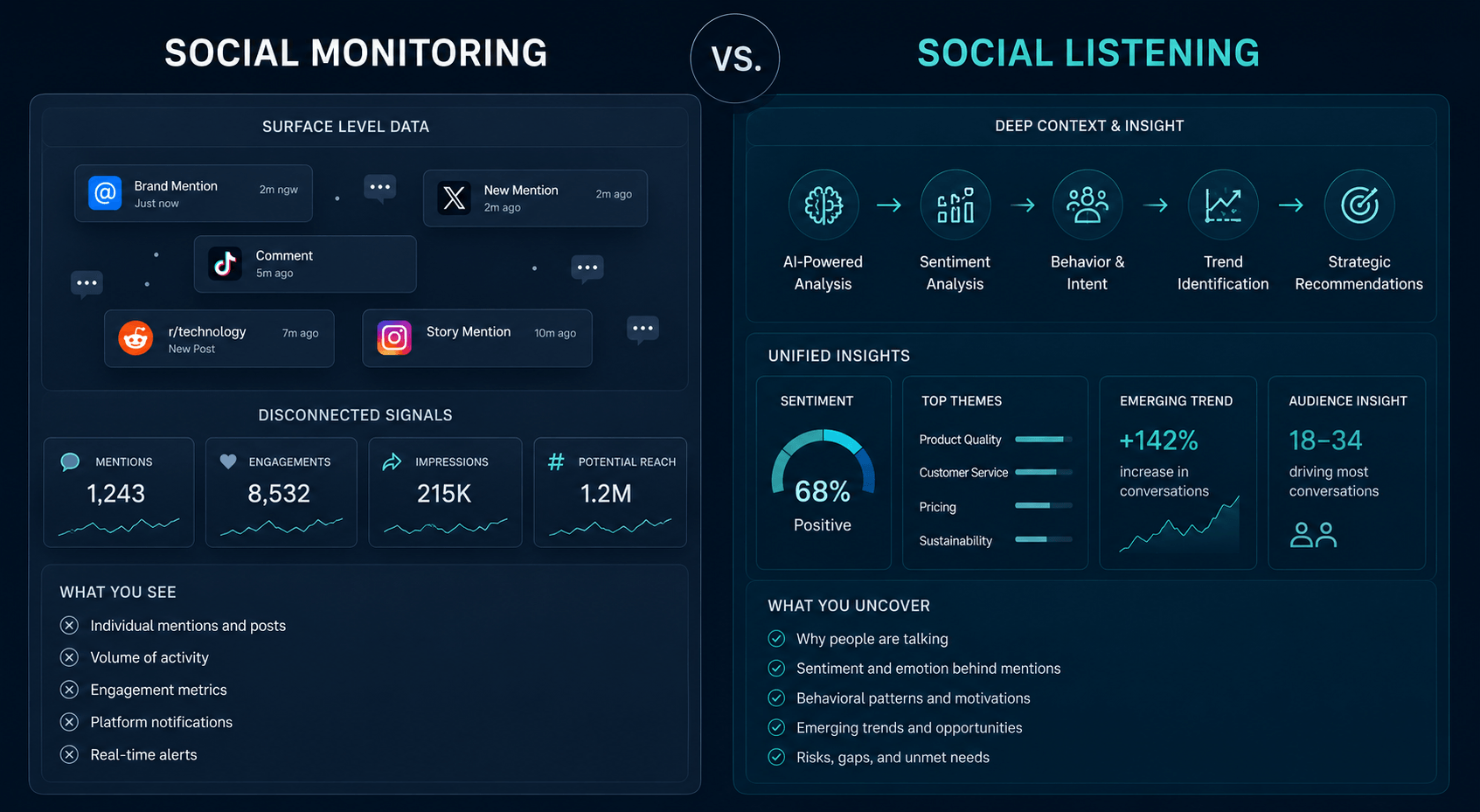
Social listening is often confused with social media monitoring—but they’re not the same thing.
At a basic level, social monitoring tracks what is being said. It focuses on metrics like mentions, tags, comments, and direct interactions with your brand.
Social listening goes deeper. It analyzes conversations at scale to uncover patterns, sentiment, intent, and insights that can influence decisions across your business.
Here’s a simple way to look at it:
| Social Monitoring | Social Listening |
| Tracks mentions | Analyzes meaning |
| Reactive | Proactive |
| Focused on metrics | Focused on insights |
| Surface-level | Strategic |
Most brands stop at monitoring.
They respond to comments, track engagement, and pull reports. That’s useful—but it only shows you what’s happening on the surface.
Agencies use social listening to go further.
Instead of asking “What are people saying about us?”, they ask:
- What are customers actually struggling with?
- How do people talk about our competitors?
- What trends are starting to emerge?
- What language are buyers using before they convert?
This is where the real value comes from.
Because when you understand the context behind the conversation, you can:
- Create more relevant content
- Improve messaging and positioning
- Identify gaps in the market
- Make faster, more informed decisions
And in a landscape where most conversations about your brand happen without you¹, that level of insight isn’t optional—it’s a competitive advantage.
Why Social Listening Matters More Than Ever
Social listening isn’t just a “nice to have” anymore—it’s become a core part of how modern marketing works.
The way people interact with brands has changed.
Today, social media isn’t just where people scroll—it’s where they discover trends, research products, compare options, and form opinions. In fact, social platforms are now one of the primary sources people use to stay up to date with trends and cultural moments².
At the same time, the landscape is more complex than ever.
- There are over 5.2 billion social media users globally³
- The average person uses nearly 7 different platforms per month³
- Users spend over 2 hours per day on social media³
That means conversations about your brand are happening everywhere—not just on Instagram or LinkedIn, but across Reddit, TikTok, forums, review sites, and niche communities.
And you’re not in control of most of them.
Brands only drive about 1% of the conversation about themselves¹. The rest is created by customers, prospects, and audiences sharing real opinions, experiences, and recommendations.
That’s exactly why social listening matters.
It gives you access to:
- Unfiltered customer feedback (what people actually think)
- Early trend signals (before they go mainstream)
- Competitive insights (how others are perceived)
- Real buying language (how customers describe problems and solutions)
It also plays a growing role in how people search.
More users—especially younger audiences—are turning to social platforms to find answers, reviews, and recommendations instead of traditional search engines4. That means the conversations happening on social are directly influencing purchase decisions.
And there’s another layer to this.
Consumers expect brands to be present and responsive. If they don’t get a response on social, 73% will consider buying from a competitor instead5. Social listening helps brands identify and respond to those moments before they turn into lost opportunities.
All of this points to one thing:
Social media is no longer just a marketing channel. It’s a real-time source of market intelligence.
And agencies that understand how to tap into that are able to make faster, smarter decisions—while others are still reacting after the fact.
How Agencies Actually Use Social Listening
Most brands use social listening to track performance.
Agencies use it to guide decisions.
That’s the key difference.
Instead of treating social listening as a reporting layer, agencies build it into how they plan, execute, and optimize marketing strategies across channels. It becomes a continuous feedback loop—not a one-time analysis.
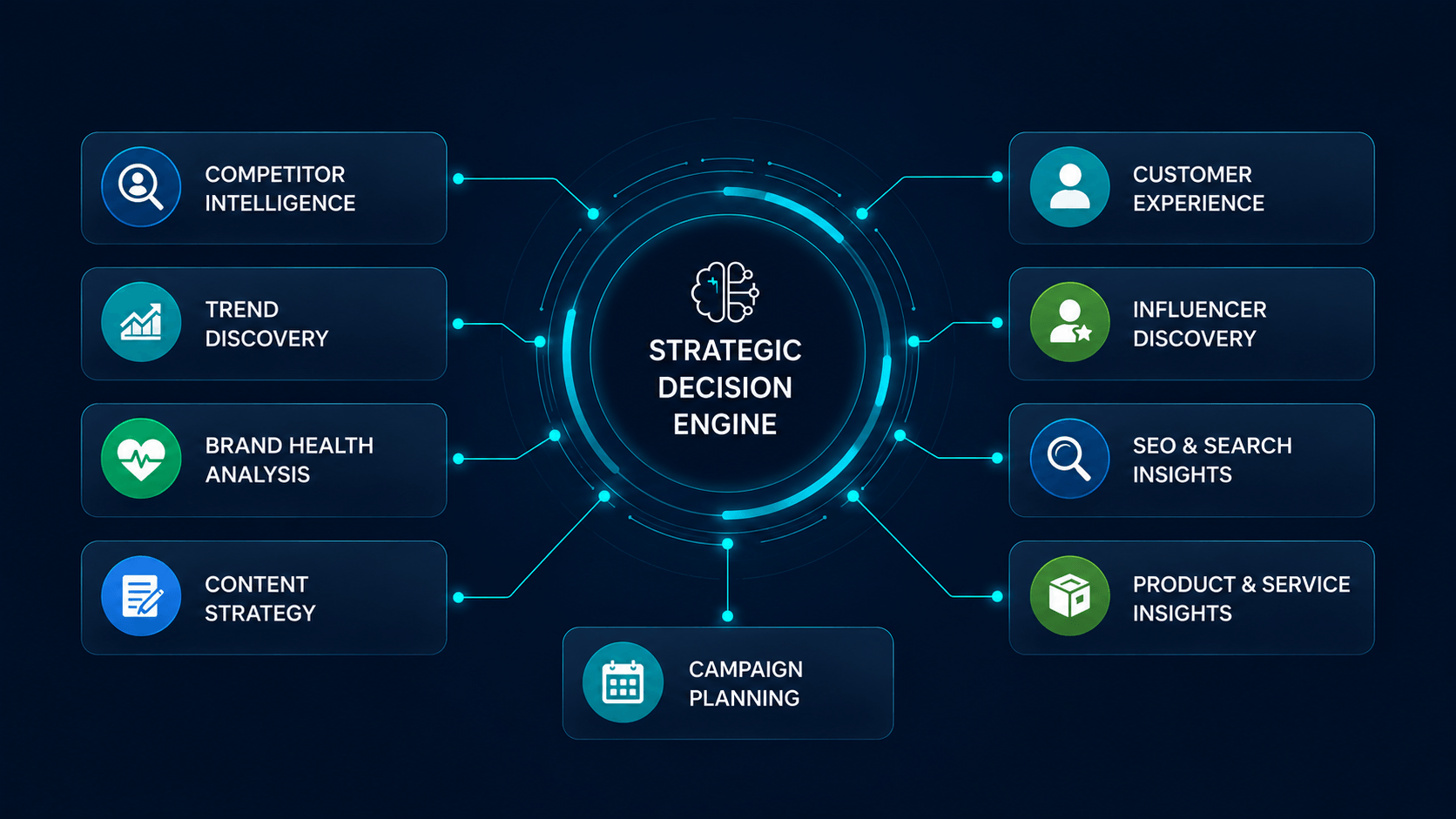
Here’s how that typically breaks down:
Core Ways Agencies Use Social Listening
- Competitive Intelligence
Understand how competitors are perceived, what messaging resonates, and where gaps exist in the market. - Trend Discovery
Identify emerging topics, behaviors, and conversations before they go mainstream—and act within the short window where relevance matters. - Brand Health & Sentiment Analysis
Track how people feel about a brand over time and pinpoint what’s driving positive or negative perception. - Customer Experience Insights
Surface complaints, friction points, and unmet needs directly from real customer conversations. - Content & Campaign Strategy
Use real audience language, questions, and interests to shape messaging, creative, and targeting. - Influencer & Creator Identification
Identify influential voices within a niche based on engagement, relevance, and audience trust—not just follower count. Agencies use this to map out potential partners for campaigns, collaborations, and user-generated content strategies that feel natural and credible.
The Shift From Data to Direction
This is where many brands fall short.
They collect data—but don’t translate it into action.
Agencies close that gap by focusing on patterns instead of isolated mentions. They look for:
- Recurring themes in conversations
- Shifts in sentiment over time
- Repeated questions or objections
- Emerging language and phrasing
That’s what turns raw data into something useful.
Because the goal of social listening isn’t to know more—it’s to make better decisions faster.
What This Leads To
When done right, social listening feeds into multiple areas of the business:
| Insight Source | What It Influences |
| Audience conversations | Content strategy |
| Competitor analysis | Positioning |
| Sentiment trends | Brand strategy |
| Customer feedback | Product & CX |
| Creator conversations | Influencer partnerships |
This is the foundation behind every technique we’ll break down next.
In the next section, we’ll get into the specific social listening techniques agencies use—and how they actually apply them in real-world scenarios.
5.1 Query Building and Boolean Search (The Foundation)
Every insight you get from social listening starts with one thing:
Your query.
If your query is weak, your data is noisy.
If your query is strong, your insights are actionable.
This is why agencies treat query building as the foundation of social listening—not an afterthought.
What Is a Social Listening Query?
A query is the set of keywords, phrases, and conditions used to pull conversations from across platforms.
At a basic level, it includes:
- Brand names
- Product names
- Industry terms
- Competitor names
But agencies go much deeper than that.
They build queries that reflect how real people actually talk, not just how brands describe themselves.
How Agencies Build Better Queries
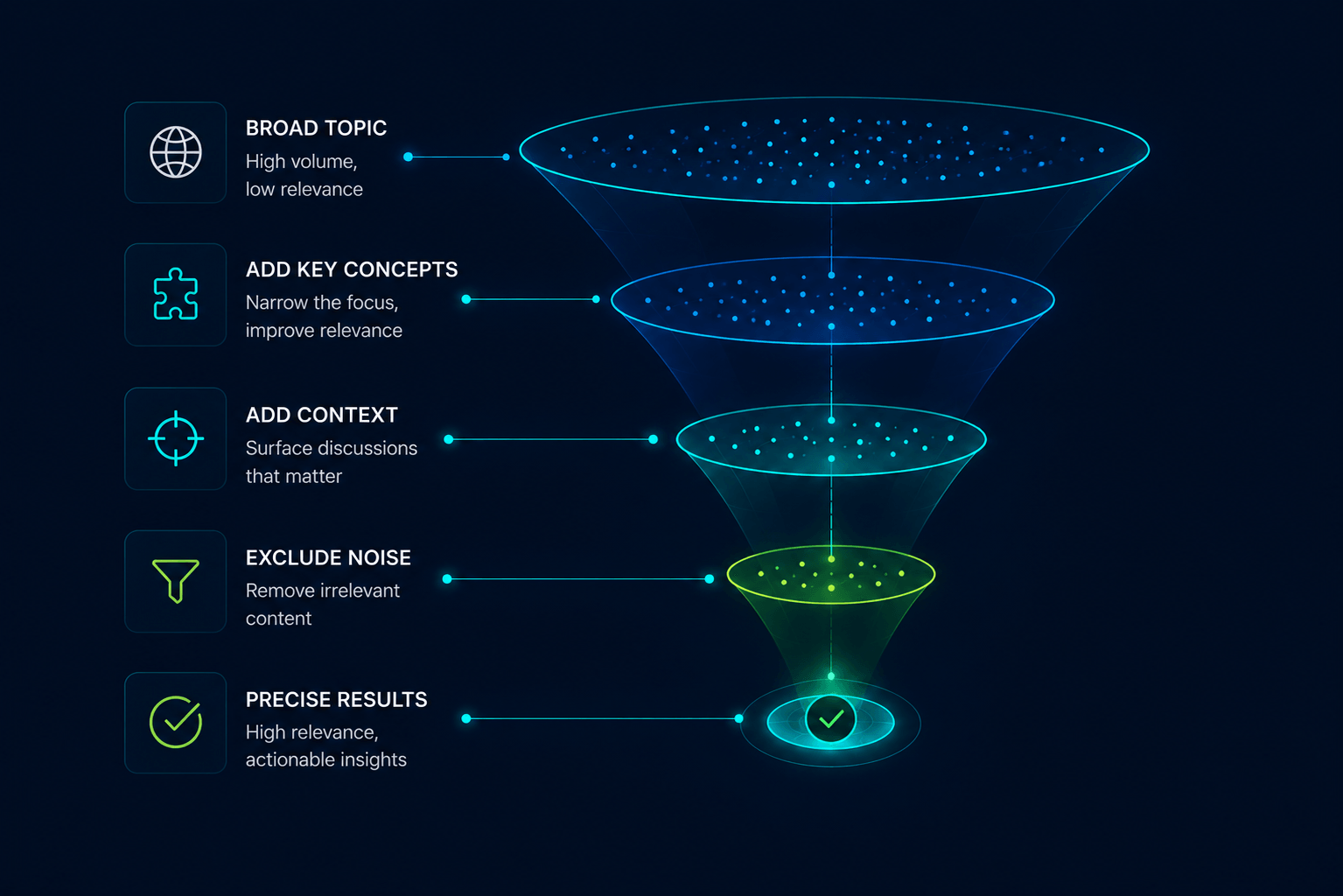
Instead of relying on a simple keyword list, agencies use Boolean logic and layered inputs to refine results and reduce noise.
That includes:
- Synonyms and variations
Different ways people describe the same thing - Misspellings and slang
Real-world language isn’t clean or consistent - Exclusions (NOT statements)
Filtering out irrelevant conversations - Context-based keywords
Pairing terms to narrow intent (e.g., “best + [product]”)
Example: Basic vs Advanced Query
| Basic Query | Advanced Query |
| “running shoes” | (“running shoes” OR sneakers OR trainers) AND (review OR best OR recommendation) NOT (jobs OR hiring) |
The difference is clear:
- The basic query pulls volume
- The advanced query pulls intent
Why This Matters
Without strong queries, you end up with:
- Irrelevant mentions
- Misleading sentiment
- Missed insights
With strong queries, you can:
- Identify real customer pain points
- Understand buying language
- Spot emerging trends earlier
- Reduce analysis time significantly
Where AI Fits In
Many agencies now use AI to support query building—suggesting variations, expanding keyword sets, and speeding up setup.
But it’s not perfect.
While over 90% of practitioners use AI in some part of the process, only a small percentage fully trust it6. That’s because context still matters, and human oversight is critical to avoid pulling the wrong data.
The Takeaway
Better queries don’t just improve your data—they change the quality of your decisions.
Because in social listening, you’re not just asking:
“What are people saying?”
You’re asking:
“Are we listening to the right conversations?”
5.2 Competitive Benchmarking
Most brands look at their own performance.
Agencies look at the entire landscape.
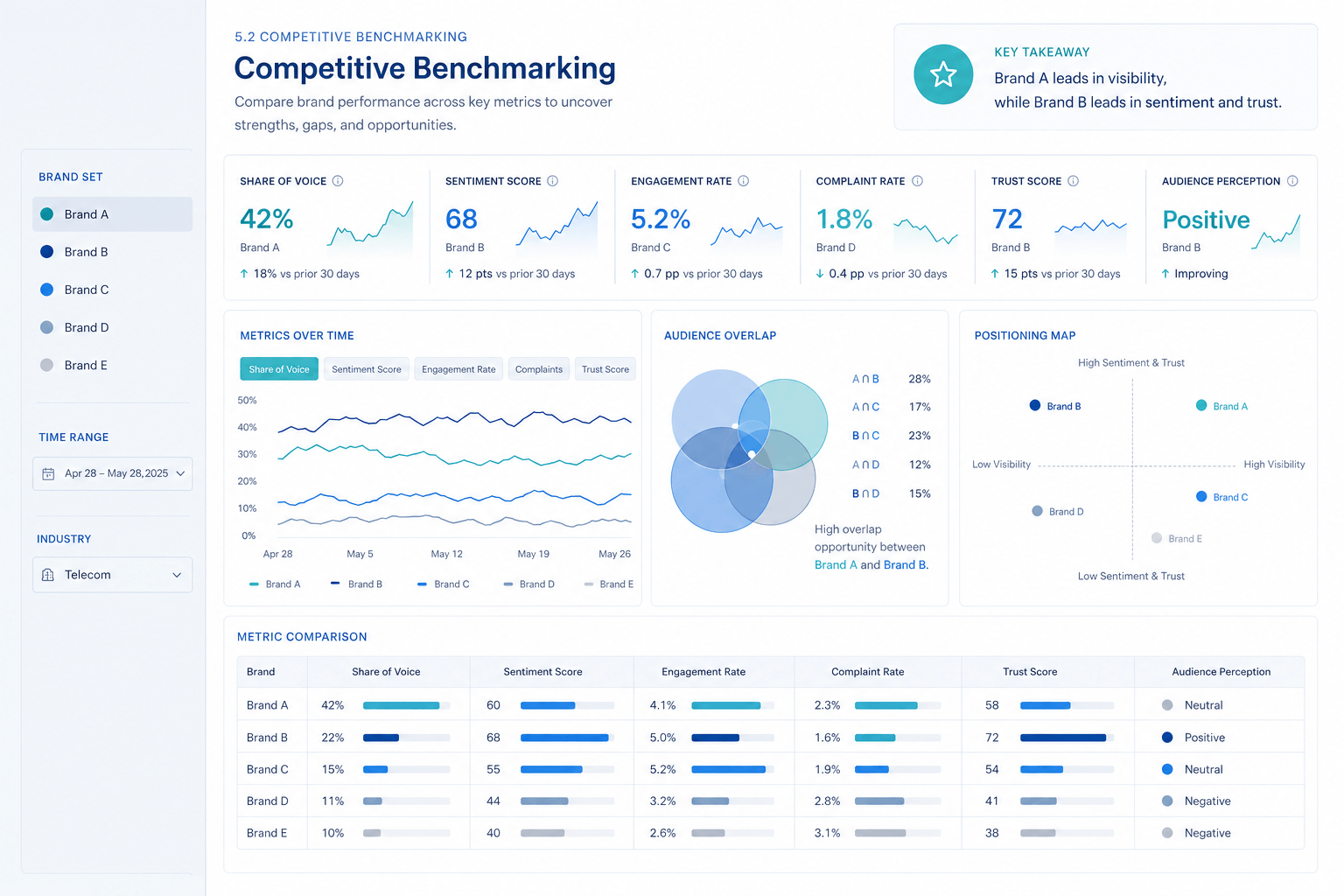
That’s what makes competitive benchmarking one of the most valuable social listening techniques—it shows you where you stand, where others are winning, and where opportunities exist.
What Competitive Benchmarking Actually Means
At its core, this technique uses social listening to compare your brand against competitors across key signals like:
- Share of voice
- Sentiment
- Engagement trends
- Campaign performance
- Audience perception
It’s not just about tracking competitors—it’s about understanding why they’re succeeding (or failing).
In fact, competitive benchmarking is one of the most common use cases for social listening among professionals today7.
What Agencies Look For
Instead of surface-level comparisons, agencies analyze patterns across competitors to uncover insights like:
- Messaging that resonates
What themes, angles, or offers are driving engagement - Gaps in positioning
Where competitors are not addressing customer needs - Audience sentiment differences
Why one brand is perceived more positively than another - Content performance trends
What formats, topics, or platforms are working best
Example: What This Looks Like in Practice
| Metric | Brand A | Brand B | Insight |
| Share of Voice | High | Low | Brand A dominates visibility |
| Sentiment | Mixed | Positive | Brand B has stronger perception |
| Engagement | Moderate | High | Brand B’s content resonates more |
| Complaints | High | Low | Opportunity for differentiation |
This kind of comparison helps agencies move from assumptions to evidence-based strategy.
Why This Matters
Without competitive benchmarking, brands tend to:
- Operate in a vacuum
- Miss shifts in the market
- Overestimate their positioning
With it, agencies can:
- Identify quick wins (what competitors are doing well)
- Spot white space opportunities (what no one is doing)
- Refine messaging and positioning
- Stay ahead of emerging trends
Beyond Direct Competitors
One of the biggest advantages agencies have is that they don’t just look at direct competitors.
They also analyze:
- Adjacent industries
- Emerging brands
- Creator-led brands
- Influencers shaping perception in the space
This expands the view beyond “who we compete with” to “what audiences are paying attention to.”
The Takeaway
Competitive benchmarking turns social listening into a strategic advantage.
Because the goal isn’t just to understand your brand—it’s to understand the market you’re competing in.
5.3 Trend and Cultural Signal Detection
Most brands react to trends.
Agencies identify them early—and act before they peak.
That’s the difference.
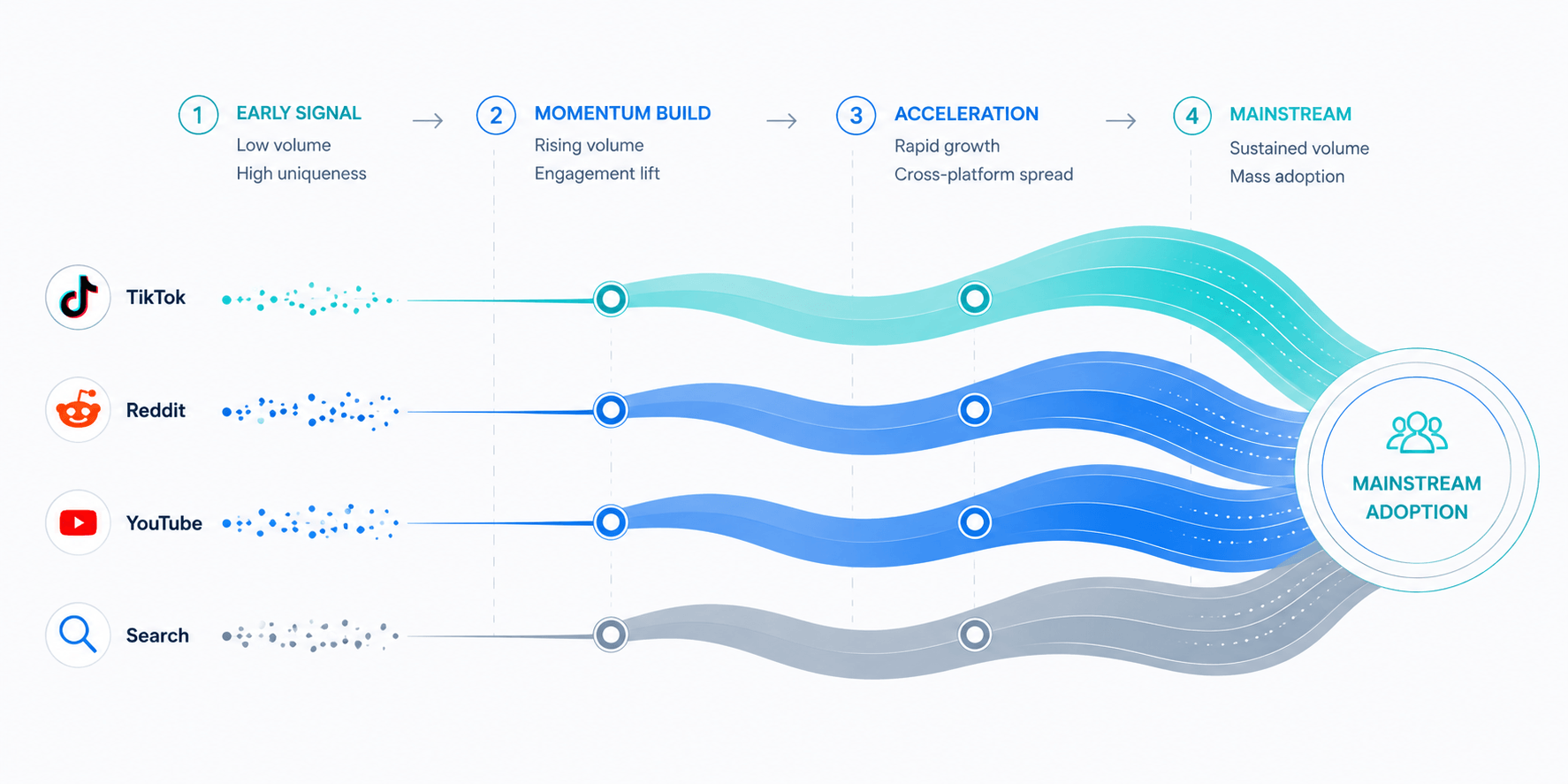
Social listening allows agencies to track how conversations evolve in real time, making it possible to spot emerging trends, shifts in behavior, and cultural signals before they become mainstream.
The Reality of Trends Today
Social media has become one of the primary sources people use to stay on top of trends and cultural moments².
But there’s a catch.
- Trends move fast
- Relevance windows are short (often 24–48 hours)²
- Not every trend is worth acting on
That’s why blindly jumping on viral content often backfires.
In fact, a significant portion of consumers think brands participating in trends can feel forced or inauthentic when it’s not done right².
How Agencies Identify Trends Early
Instead of chasing what’s already viral, agencies look for early signals.
They monitor:
- Sudden spikes in conversation volume
- New or rapidly growing keywords and hashtags
- Recurring themes across different platforms
- Shifts in audience sentiment or tone
The goal is to identify patterns before they explode.
Trend vs Noise
One of the most important skills in social listening is knowing the difference between a real trend and temporary noise.
| Signal | What It Means |
| Consistent growth | Likely trend |
| One-time spike | Likely noise |
| Cross-platform presence | Strong signal |
| Niche-only mentions | Early-stage opportunity |
Agencies don’t just ask “Is this trending?”
They ask “Is this worth acting on?”
Why Timing Matters
Even when a trend is relevant, timing is everything.
Act too late, and your content feels forced.
Act too early, and there’s no audience yet.
Social listening helps agencies find that sweet spot—when a trend is gaining traction but not yet saturated.
How This Impacts Strategy
When done right, trend detection feeds directly into:
- Content creation (topics people already care about)
- Campaign timing (launching when interest is rising)
- Messaging relevance (using language audiences are already using)
- Creative direction (formats and styles that are gaining traction)
The Takeaway
Trend detection isn’t about going viral.
It’s about staying relevant.
Agencies use social listening to understand where attention is moving—so they can position brands in the right conversations at the right time.
5.4 Sentiment and Brand Health Analysis
Not all attention is good attention.
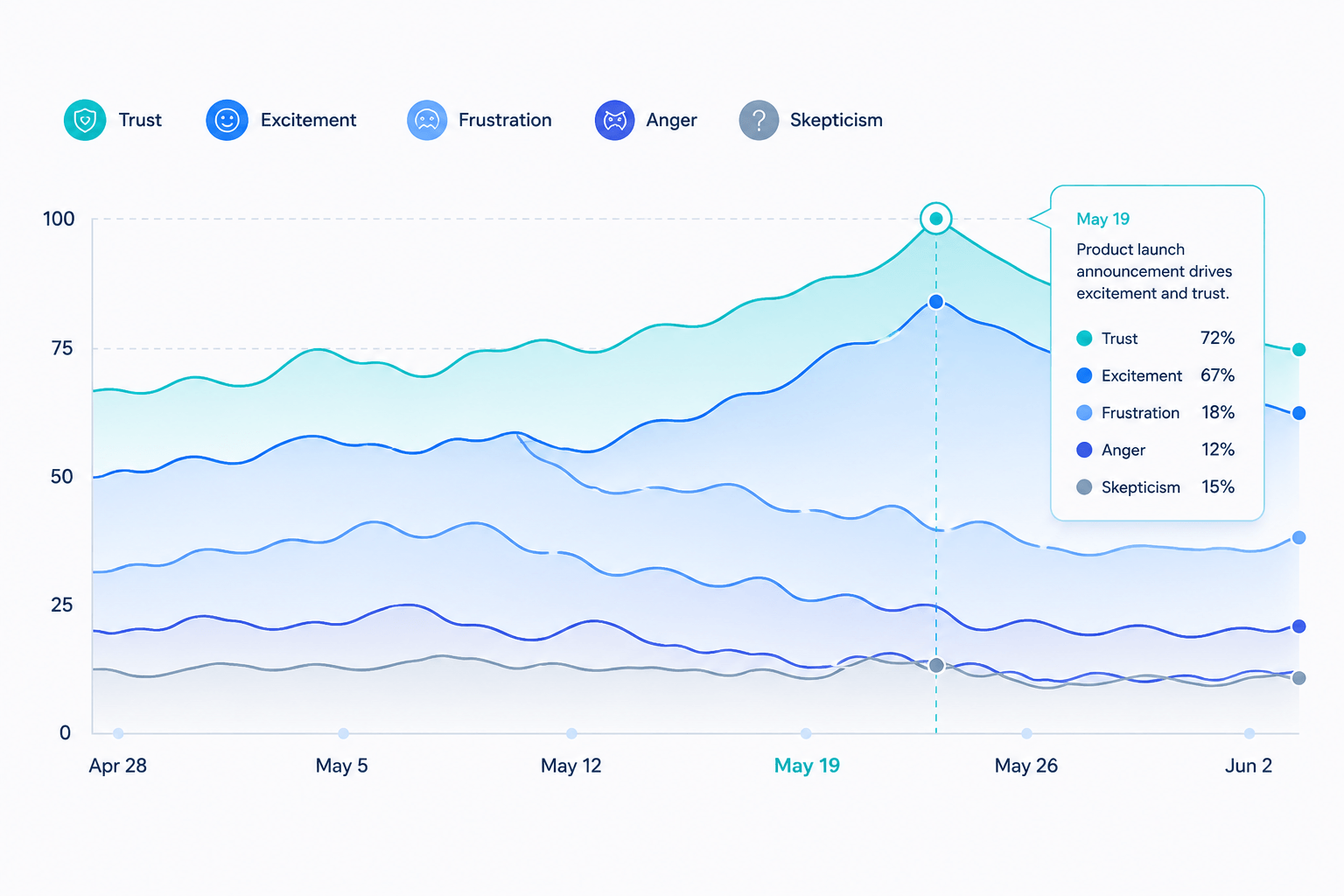
That’s why agencies don’t just track how often a brand is mentioned—they track how people feel about it.
This is where sentiment and brand health analysis come in.
What Is Sentiment Analysis?
Sentiment analysis looks at the tone of conversations and categorizes them as:
- Positive
- Neutral
- Negative
But agencies go a step further.
They don’t just measure sentiment—they analyze what’s driving it.
Because a spike in negative sentiment doesn’t mean much unless you understand why it’s happening.
Going Beyond Sentiment: Emotion Analysis
Some tools and agencies also break sentiment down into more specific emotions, such as:
- Joy
- Anger
- Frustration
- Fear
This matters because not all negative sentiment is equal.
For example:
- Frustration might point to a product or UX issue
- Anger could signal a PR or reputation problem
- Fear might relate to trust or safety concerns
Different emotions require different responses.
What Agencies Look For
Instead of just tracking percentages, agencies analyze patterns like:
- Changes in sentiment over time
- Spikes tied to specific events or campaigns
- Recurring complaints or praise
- Differences in perception across platforms
This helps them move from “reporting sentiment” to understanding perception.
Example: What This Looks Like
| Signal | What It Indicates |
| Rising negative sentiment | Potential issue emerging |
| Repeated complaints | Product or CX gap |
| Positive spikes | Campaign success |
| Platform-specific sentiment | Channel-specific issue |
Why This Matters
Without sentiment analysis, brands risk:
- Missing early warning signs
- Misinterpreting audience reactions
- Responding too late to issues
With it, agencies can:
- Detect problems before they escalate
- Understand what customers actually value
- Refine messaging based on perception
- Protect and strengthen brand reputation
The Reality: You Don’t Control the Narrative
Most conversations about your brand happen without you¹.
That means your reputation is being shaped whether you’re paying attention or not.
Sentiment analysis gives you visibility into that reality—and the ability to respond strategically instead of reactively.
The Takeaway
Brand health isn’t just about awareness.
It’s about perception.
And agencies use social listening to continuously measure, analyze, and improve how a brand is seen—so they can influence not just visibility, but trust.
5.5 Audience and Community Insights
If you want to understand your audience, don’t just look at your analytics.
Listen to how they talk when you’re not in the room.
That’s exactly what agencies do.
Why This Matters
Your audience behaves differently depending on where they are.
What they say in a comment on your post is not the same as what they say in:
- Reddit threads
- Niche forums
- Review sites
- Private communities
Those spaces tend to be more honest, more detailed, and more revealing.
And that’s where some of the most valuable insights come from.
Where Agencies Actually Look
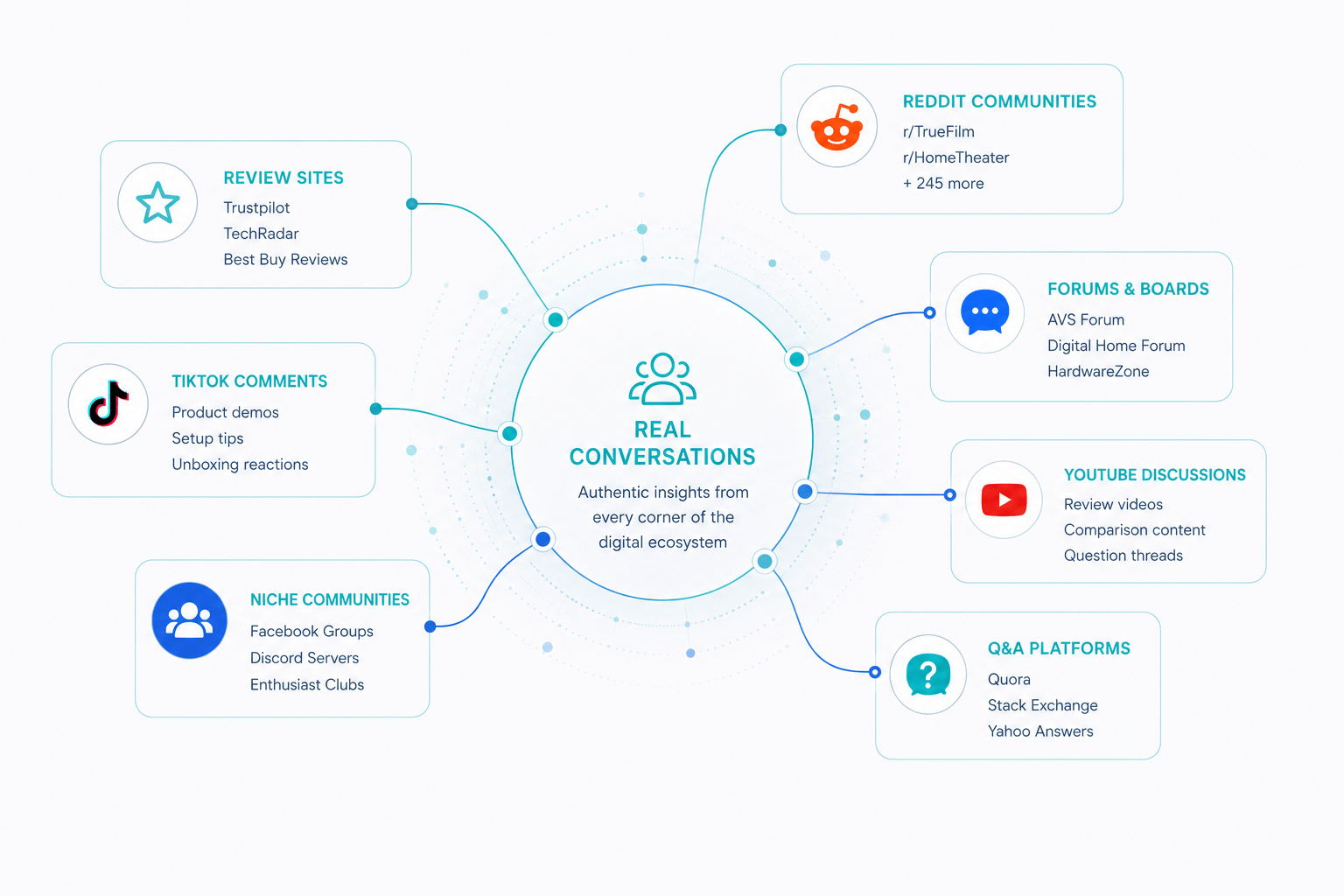
Agencies don’t limit listening to mainstream platforms.
They actively monitor:
- Reddit and community forums (deep discussions and real opinions)
- Review platforms (product feedback and complaints)
- TikTok and short-form content (emerging language and trends)
- Comment sections (raw, unfiltered reactions)
This matters even more as users shift toward community-based platforms, where conversations are more niche and more influential.
What Agencies Are Looking For
Instead of surface-level engagement metrics, agencies focus on:
- Pain points
What problems people are consistently mentioning - Questions and objections
What’s stopping someone from buying - Language and phrasing
How customers naturally describe problems and solutions - Recurring themes
What topics keep coming up across platforms
Why Language Matters
One of the most overlooked benefits of social listening is understanding how your audience talks.
Not how your brand talks.
Not how your industry talks.
How customers talk.
This directly impacts:
- Ad copy
- Website messaging
- SEO keywords
- Content topics
Because when your messaging mirrors your audience’s language, it becomes instantly more relatable and effective.
Example: Turning Insights Into Action
| Insight | What You Do With It |
| Repeated complaints | Improve product or messaging |
| Common questions | Create content or FAQs |
| Objections | Adjust positioning |
| Language patterns | Refine copywriting |
The Hidden Advantage
Most brands rely on surveys, feedback forms, or internal assumptions.
Agencies rely on real conversations happening at scale.
That’s the difference.
Because instead of asking customers what they think, you’re observing what they actually say—unprompted.
The Takeaway
Audience insights aren’t just about demographics.
They’re about understanding behavior, language, and intent.
And social listening gives agencies a direct line into that—without filters, assumptions, or guesswork.
5.6 Social Search and Intent Mining
People aren’t just scrolling on social media anymore.
They’re searching.
And that shift has quietly changed how agencies approach social listening.
The Rise of Social Search
More users—especially younger audiences—are turning to platforms like TikTok, Instagram, and Reddit to:
- Find product recommendations
- Compare options
- Read reviews
- Learn how things work
In fact, a growing percentage of users now use social platforms as their first stop for discovery and research, often before traditional search engines4.
That means the conversations happening on social are no longer just noise—they’re high-intent signals.
What Agencies Extract From Social Search
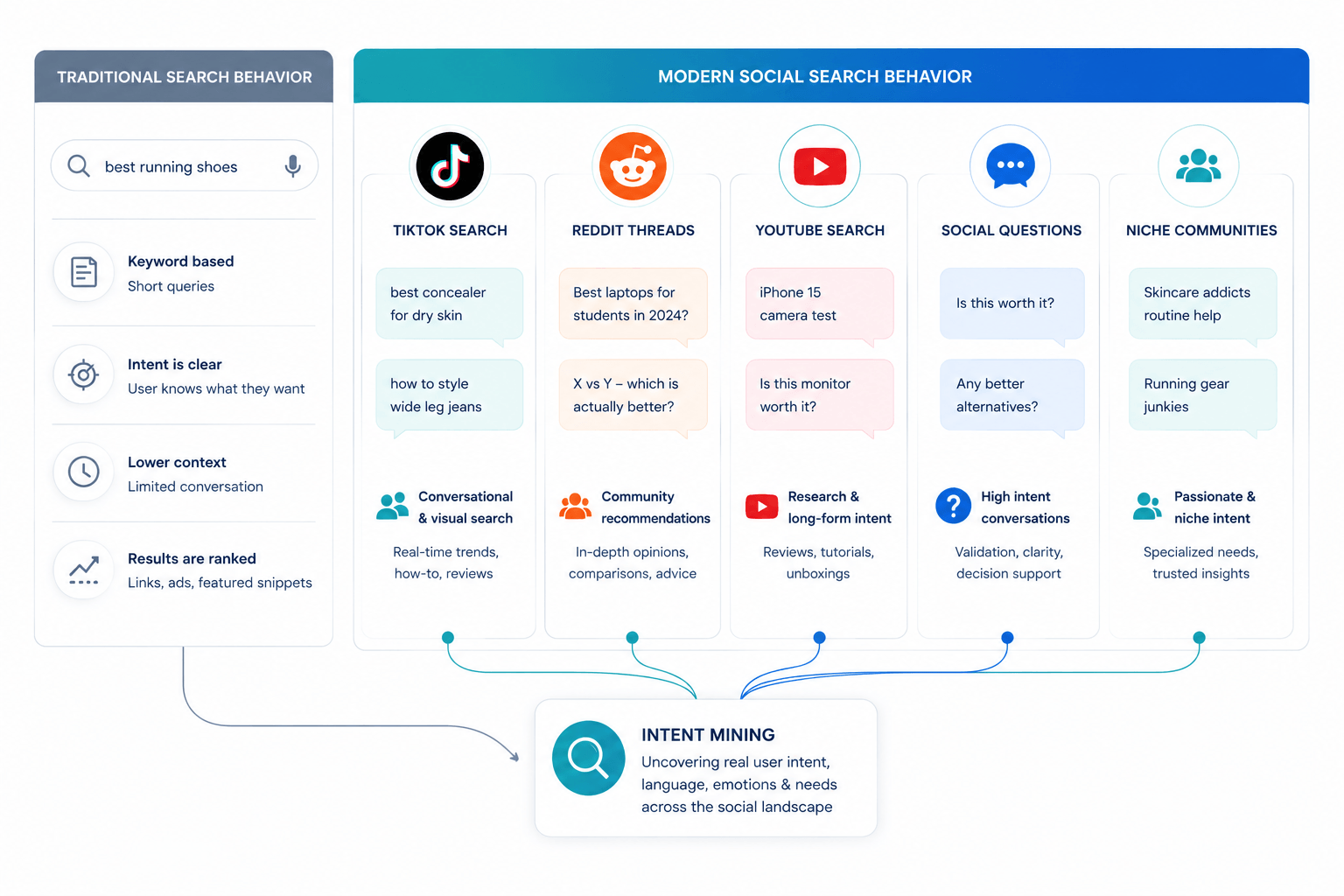
Agencies use social listening to mine this behavior and uncover:
- Questions people are asking
(“What’s the best…”, “Is X worth it?”, “How do I…”) - Comparisons
(“Brand A vs Brand B”, “X alternative”) - Buying signals
(“Thinking of buying…”, “Has anyone tried…”) - Objections and concerns
(“Is this legit?”, “Too expensive?”, “Does it actually work?”)
This is some of the most valuable data you can get.
Because it shows exactly where someone is in the decision-making process.
Why This Is So Powerful
Traditional keyword research tells you what people search.
Social listening shows you:
- How they phrase it
- What context they include
- What emotions are behind it
- What influences their decision
That added layer of context is what makes messaging more effective.
Example: Search vs Social Intent
| Traditional Search | Social Search |
| “best CRM software” | “what CRM are you guys using that actually works?” |
| “running shoes reviews” | “anyone tried these? worth it?” |
| “foundation repair cost” | “is this normal or am I getting ripped off?” |
The difference is clear:
Social search is more conversational, emotional, and detailed.
How Agencies Use This Data
Social search insights feed directly into:
- SEO strategy (content topics + long-tail keywords)
- Ad copy (mirroring real questions and objections)
- Landing pages (addressing concerns upfront)
- Content creation (answering real-world questions)
It’s one of the most effective ways to align messaging with real buyer intent.
The Takeaway
If you’re only relying on traditional search data, you’re missing context.
Social listening fills that gap.
It shows you not just what people are looking for—but how they think, what they care about, and what drives their decisions.
5.7 Crisis Detection and Response Signals
By the time a crisis is obvious, it’s already too late.
Agencies use social listening to catch problems before they escalate—when they’re still small, scattered, and manageable.
What Counts as a “Crisis”?
Not every issue is a full-blown PR disaster.
In most cases, crises start as:
- A spike in complaints
- A negative review gaining traction
- A frustrated customer post getting engagement
- A recurring issue people keep mentioning
Individually, these don’t seem like much.
Together, they form a pattern.
And that’s what agencies are trained to spot.
How Agencies Detect Issues Early
Instead of waiting for something to go viral, agencies monitor early warning signals, such as:
- Sudden increases in negative sentiment
- Unusual spikes in brand mentions
- Recurring complaints across platforms
- Influencers or high-visibility accounts discussing an issue
These signals often appear before a situation becomes public or widespread.
Why Speed Matters
Social moves fast.
If a brand doesn’t respond in time, it can lose control of the narrative—and the consequences are real.
- Consumers expect quick responses
- Frustration escalates quickly when ignored
- Negative sentiment spreads faster than positive
In fact, if brands don’t respond on social, 73% of users will consider switching to a competitor instead5.
Example: Early Signal vs Full Crisis
| Stage | What It Looks Like |
| Early signal | Small spike in complaints |
| Growing issue | Multiple posts gaining traction |
| Escalation | Influencers or media involved |
| Crisis | Widespread negative coverage |
The goal is to act in the early stages, not the last one.
What Agencies Do With This Information
Once an issue is identified, agencies help brands:
- Prioritize responses (what needs immediate attention)
- Identify the root cause (product, service, messaging, etc.)
- Coordinate internal teams (marketing, support, leadership)
- Adjust messaging quickly to address concerns
This turns social listening into a risk management tool, not just a marketing function.
The Takeaway
Crisis detection isn’t about reacting faster.
It’s about seeing problems earlier.
And social listening gives agencies that visibility—so they can step in before a small issue turns into a brand-level problem.
5.8 AI-Assisted Analysis (And Its Limits)
AI has become a major part of social listening workflows.
But it hasn’t replaced strategy.
Agencies use AI to move faster—but they don’t rely on it to think for them.
Where AI Actually Helps
With the volume of data social listening produces, AI plays an important role in making analysis scalable.
Agencies use it to:
- Summarize large datasets
Quickly turn thousands of mentions into digestible insights - Cluster conversations
Group similar themes, topics, and patterns - Identify anomalies
Spot unusual spikes or changes in data - Support query building
Suggest keyword variations and expansions
This allows teams to spend less time sorting data—and more time interpreting it.
The Reality: AI Still Has Limits
Even though adoption is high, trust is not.
While over 90% of practitioners use AI in some part of their workflow, only a small percentage fully trust it6.
That’s because AI can:
- Misinterpret sarcasm or tone
- Miss cultural context
- Overgeneralize insights
- Pull in irrelevant data if queries aren’t strong
In other words, AI is only as good as the inputs—and the human reviewing the outputs.
How Agencies Use AI the Right Way
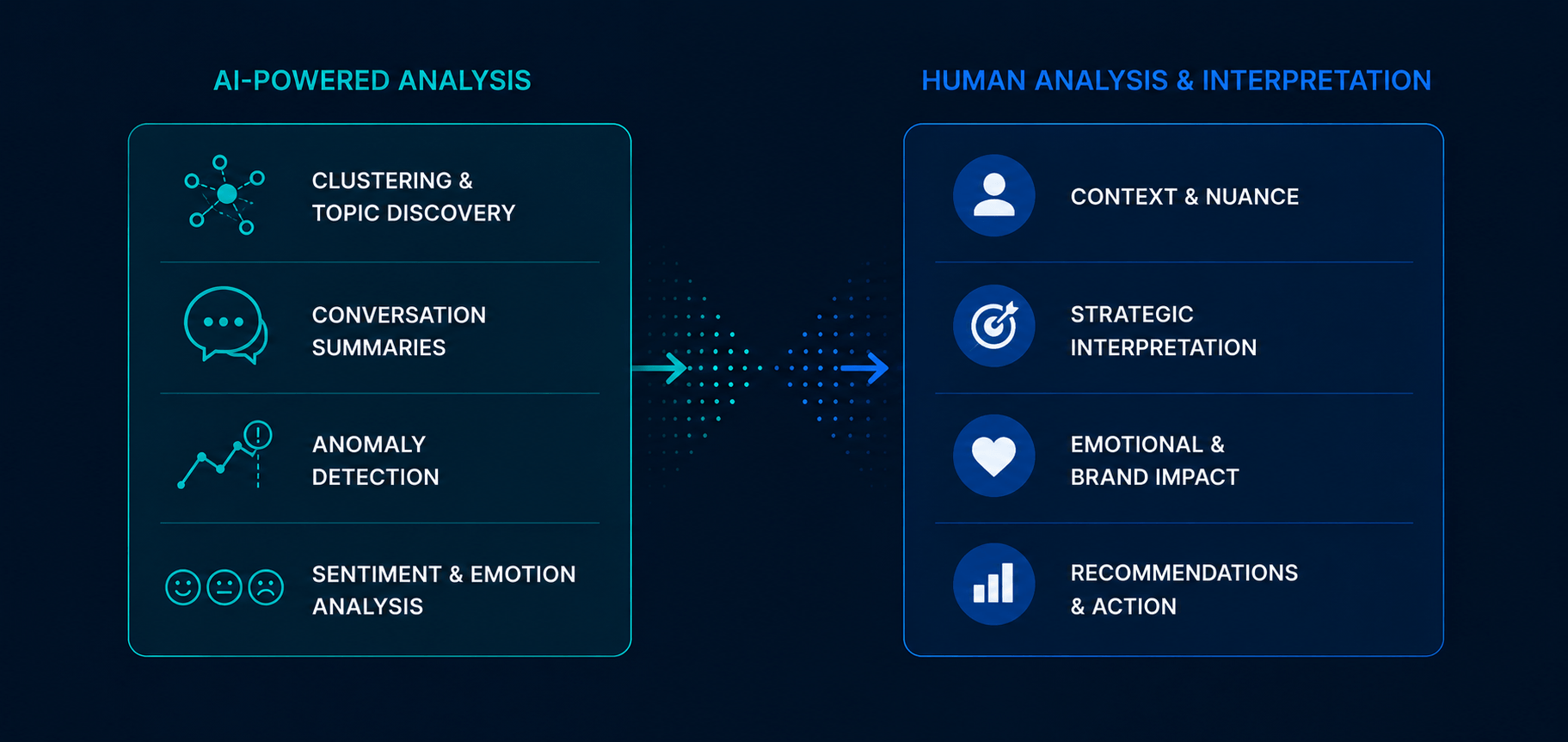
Instead of treating AI as a replacement, agencies use it as a first layer of analysis.
The process typically looks like this:
- AI processes and summarizes the data
- Analysts review and validate the insights
- Teams connect findings to strategy and execution
This hybrid approach balances speed and accuracy.
Why Human Insight Still Matters
Social listening isn’t just about identifying patterns—it’s about understanding meaning.
And meaning requires:
- Context
- Experience
- Strategic thinking
Things AI still struggles to replicate.
That’s why agencies don’t just ask:
“What does the data say?”
They ask:
“What does this actually mean for the business?”
The Takeaway
AI makes social listening more efficient.
But it doesn’t make it strategic.
Agencies that get the most value from social listening are the ones that combine technology with human insight—using AI to accelerate the process, not define it.
What Most Brands Get Wrong About Social Listening
Most brands are doing something with social listening.
Very few are doing it well.
The issue isn’t access to tools or data—it’s how that data is used.
1. Treating It Like a Reporting Tool
This is the most common mistake.
Brands track mentions, pull engagement reports, and monitor performance. That’s useful—but it’s surface-level.
Social listening isn’t about reporting what happened.
It’s about understanding why it happened—and what to do next.
2. Only Listening to Direct Mentions
If you’re only tracking your brand name, you’re missing most of the conversation.
Remember: brands only drive about 1% of the discussion about themselves¹.
That means the real insights are happening in:
- Indirect conversations
- Competitor mentions
- Industry discussions
- Community threads
Agencies expand beyond brand mentions to capture the full context of the market.
3. Ignoring Non-Mainstream Platforms
Many brands focus only on platforms like Instagram, LinkedIn, or X.
But some of the most valuable insights come from:
- Forums
- Review sites
- Niche communities
These are often where people are more honest, more detailed, and more influential in shaping opinions.
4. Collecting Data Without Acting on It
Data alone doesn’t create value.
Insights do.
And insights only matter if they lead to action.
Brands often gather large amounts of data but fail to:
- Translate it into strategy
- Share it across teams
- Use it to guide decisions
Agencies bridge that gap by turning insights into clear next steps.
5. Chasing Trends Instead of Understanding Them
Jumping on trends without context is risky.
As we’ve seen, a significant portion of consumers find trend participation forced or inauthentic when it’s not done right².
The problem isn’t using trends—it’s reacting too late or without understanding why they matter.
Agencies focus on identifying trends early and aligning them with brand strategy—not just visibility.
6. Over-Relying on Tools
Tools are important—but they’re not the strategy.
Many brands assume that having access to a platform means they’re “doing social listening.”
In reality:
- Tools collect data
- People interpret it
- Strategy turns it into impact
Without that middle layer, tools become dashboards—not decision drivers.
The Takeaway
Social listening isn’t about doing more.
It’s about doing it differently.
The brands that get the most value from it aren’t the ones with the most data—they’re the ones that know how to turn that data into decisions.
How Social Listening Connects to Real Business Outcomes
Social listening is only valuable if it leads to action.
This is where agencies separate themselves.
They don’t just gather insights—they connect them directly to business outcomes.
Turning Insights Into Impact
Every data point from social listening should answer one question:
“What do we do with this?”
Agencies use social listening to influence decisions across multiple areas:
- Content strategy
Create topics based on real conversations, not assumptions - Paid media performance
Refine ad messaging using actual customer language and objections - SEO and organic growth
Identify long-tail keywords and questions people are already asking - Product and service improvements
Surface recurring issues and unmet needs - Customer experience (CX)
Improve response times, support messaging, and overall satisfaction
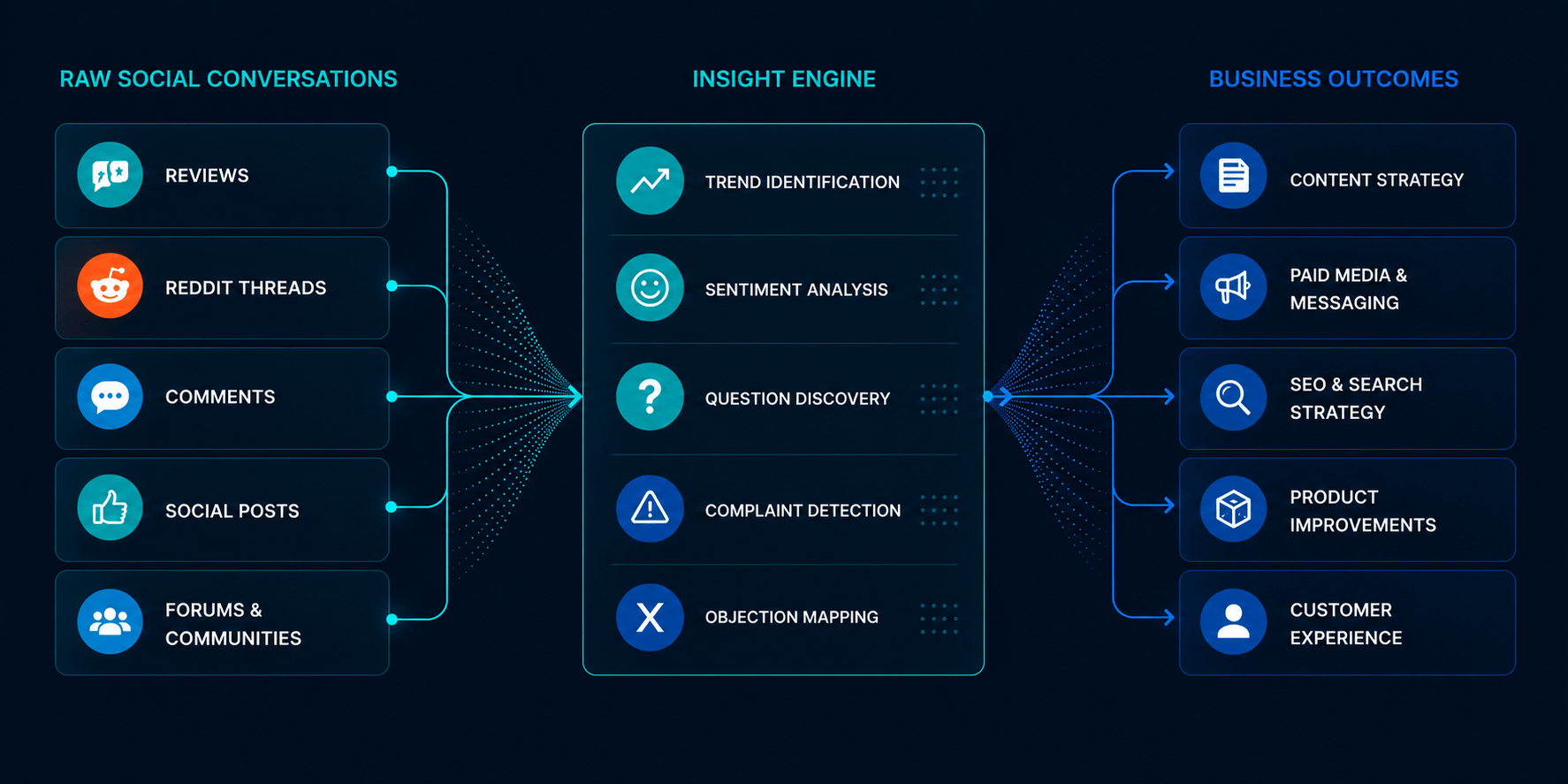
What This Looks Like in Practice
| Insight Type | Business Impact |
| Trends | Content ideas |
| Sentiment | Brand strategy |
| Questions | SEO + ads |
| Complaints | CX improvements |
Why This Matters
Without this connection, social listening becomes:
- Interesting—but not actionable
- Informative—but not impactful
- Data-heavy—but decision-light
With it, it becomes a growth driver.
Because instead of guessing what your audience wants, you’re building strategies based on:
- Real conversations
- Real behaviors
- Real intent
The Competitive Advantage
Most brands still rely on:
- Internal assumptions
- Limited feedback
- Lagging indicators
Agencies rely on real-time market intelligence.
That allows them to:
- Make faster decisions
- Adapt strategies quickly
- Stay aligned with audience needs
The Takeaway
Social listening doesn’t just help you understand your audience.
It helps you build a better business around them.
And when those insights are consistently applied across marketing, product, and customer experience, they create a compounding advantage over time.
Tools Agencies Use for Social Listening
Tools are what make social listening possible at scale.
But they’re not what make it effective.
Agencies don’t win because of the tools they use—they win because of how they use them.
Common Social Listening Tools
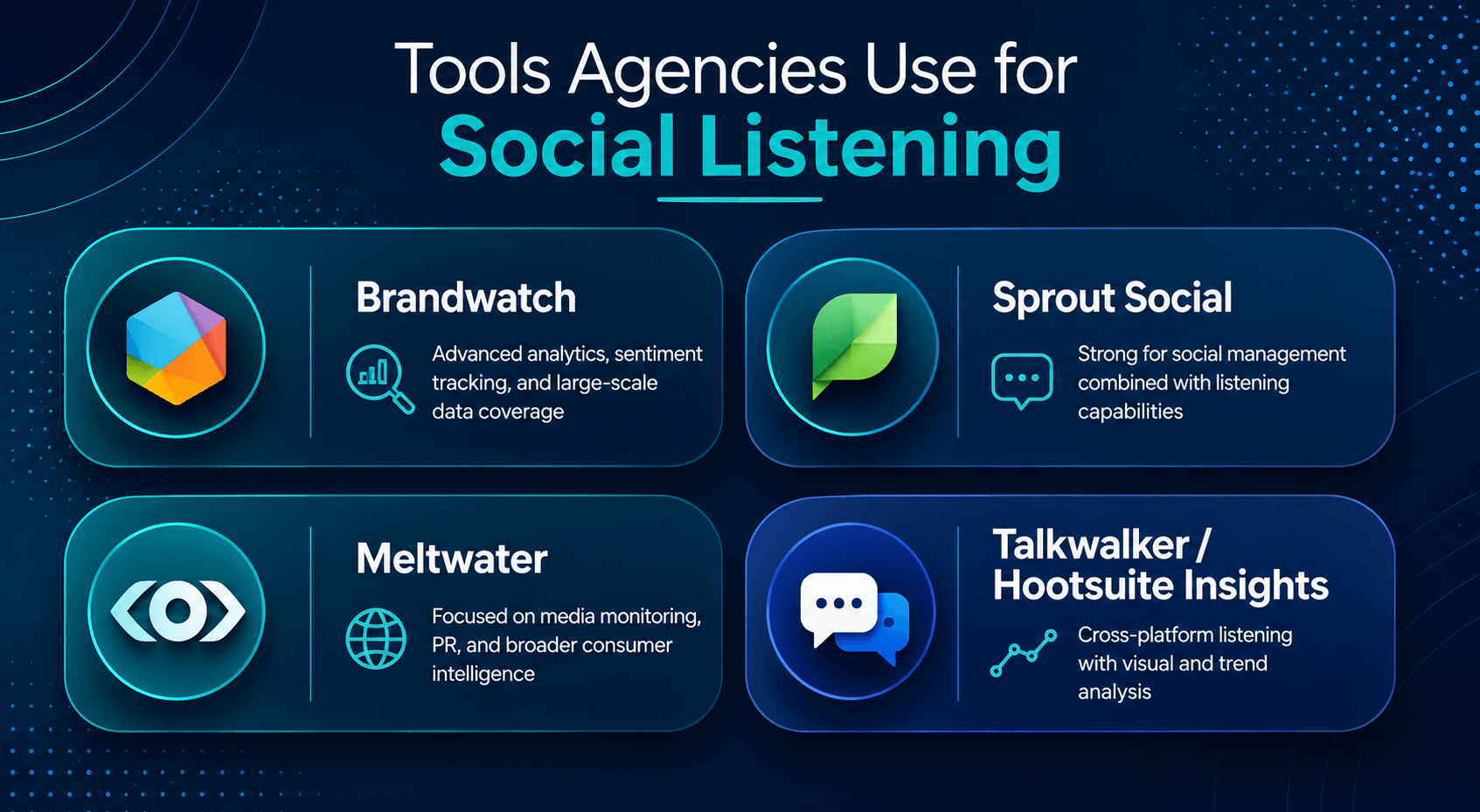
There are several platforms agencies rely on to collect and analyze data across social channels:
- Brandwatch: Advanced analytics, sentiment tracking, and large-scale data coverage
- Sprout Social: Strong for social management combined with listening capabilities
- Meltwater: Focused on media monitoring, PR, and broader consumer intelligence
- Talkwalker / Hootsuite Insights: Cross-platform listening with visual and trend analysis
Each tool has its strengths, but they all serve the same purpose:
Turning conversations into data you can analyze.
What These Tools Actually Do
At a high level, social listening tools help agencies:
- Aggregate conversations from multiple platforms
- Track keywords, mentions, and topics
- Analyze sentiment and trends
- Visualize data through dashboards and reports
This is what allows agencies to move from scattered conversations to structured insights.
Where Most Brands Go Wrong
Many businesses think:
“Once we have the tool, we’re doing social listening.”
That’s not how it works.
Without:
- Strong queries
- Clear goals
- Ongoing analysis
- Strategic interpretation
Even the best tools will just give you more data—not better decisions.
Tools vs Strategy
Here’s the reality:
| Tools | Strategy |
| Collect data | Interpret meaning |
| Automate tracking | Guide decisions |
| Provide dashboards | Drive action |
| Scale efforts | Create impact |
Tools are necessary—but they’re not sufficient.
The Agency Advantage
Agencies know how to:
- Set up tools correctly
- Build effective queries
- Filter out noise
- Identify meaningful patterns
- Translate insights into action
That’s what turns a platform into a competitive advantage.
The Takeaway
Social listening tools are powerful.
But they’re only as valuable as the strategy behind them.
Because at the end of the day, the goal isn’t to collect more data—it’s to make better decisions with it.
How to Start Using Social Listening Like an Agency
You don’t need a massive team or enterprise setup to start using social listening effectively.
But you do need a clear approach.
Agencies follow a structured process that turns scattered conversations into actionable insights. Here’s a simplified version you can apply:
Step 1: Define What You Want to Learn
Before you open any tool, get clear on your goal.
Are you trying to:
- Understand customer pain points?
- Analyze competitors?
- Improve messaging?
- Identify trends?
Your objective will shape everything—from your queries to how you interpret data.
Step 2: Build Strong Queries
This is the most important step.
Start with:
- Brand and product names
- Competitor names
- Industry keywords
Then expand with:
- Synonyms and variations
- Questions and intent-based phrases
- Exclusions to remove irrelevant data
Better queries = better insights.
Step 3: Choose Where to Listen
Don’t limit yourself to one platform.
Look where your audience actually talks:
- Social platforms (Instagram, TikTok, LinkedIn)
- Reddit and forums
- Review sites
- Comment sections
Remember, some of the most valuable insights come from less obvious places.
Step 4: Look for Patterns, Not Just Mentions
Avoid focusing on individual comments.
Instead, look for:
- Repeated complaints
- Common questions
- Recurring themes
- Shifts in sentiment
This is what turns data into insight.
Step 5: Turn Insights Into Action
This is where most brands fall short.
For every insight you find, ask:
“What do we do with this?”
Then apply it to:
- Content topics
- Ad messaging
- Website copy
- Customer experience improvements
Step 6: Make It Ongoing
Social listening isn’t a one-time project.
It works best as a continuous feedback loop:
- Monitor - Analyze - Apply - Repeat
This is how agencies stay aligned with real-time audience behavior.
Quick Summary
| Step | Focus |
| Define goals | What you want to learn |
| Build queries | What you listen for |
| Choose platforms | Where you listen |
| Analyze patterns | What it means |
| Take action | What you do next |
The Takeaway
You don’t need more data.
You need a better way to use it.
When you approach social listening with structure and intent, it becomes more than a marketing tactic—it becomes a decision-making system.
From Social Listening to Strategic Action
Social listening isn’t just about tracking conversations.
It’s about understanding them—and using that understanding to make better decisions.
Most brands stop at the surface. They monitor mentions, track engagement, and report on what happened.
Agencies go deeper.
They use social listening to uncover patterns, identify opportunities, anticipate trends, and shape strategy across marketing, content, and customer experience. It becomes a continuous source of insight—not a one-time report.
And in a landscape where:
- Brands only drive about 1% of conversations about themselves¹
- Social platforms influence how people research, compare, and buy4
- Conversations are happening across multiple fragmented channels³
…that level of visibility is no longer optional.
It’s a competitive advantage.
The brands that win aren’t the ones with the most data.
They’re the ones that know how to turn conversations into action.
Ready to Turn Social Insights Into Strategy?
If you’re not sure where to start—or if your current social strategy feels disconnected from real audience behavior—this is where the right partner makes the difference.
At Digital Division, we don’t just track data.
We help you:
- Turn insights into clear strategy
- Align your messaging with real customer language
- Identify opportunities your competitors are missing
- Build systems that continuously improve performance
Whether you need support with social media, SEO, paid ads, or overall marketing strategy, we act as a partner—helping you connect the dots and drive real growth.
Get in touch with Digital Division for a consultation
Sources
- Brandwatch – State of Social 2025
- Sprout Social – Consumer Trends & Cultural Relevance Research
- DataReportal – Digital 2025 Global Overview Report
- Sprout Social – Social Search Behavior Study
- Sprout Social – Customer Care on Social Media Statistics
- The Social Intelligence Lab – State of Social Listening 2025
DIGITAL MARKETING SOLUTIONS
Relax.
You've got a digital marketing partner.
Digital Division is a marketing agency with solutions that can help you generate leads and transform your business.