

Tools Professional Google Ads Agencies Use to Track, Report, and Improve Results
Key Takeaways
- Google Ads alone does not show the full performance picture
- Agencies use advanced tools to track real lead quality and revenue
- Call tracking and attribution tools reveal what actually drives results
- Reporting dashboards turn complex data into clear decisions
- Optimization tools help spot wasted spend faster
- AI tools speed up analysis, but strategy still requires human expertise
- Agencies invest in expensive software stacks most businesses would not buy
- That gives clients access to better tracking, reporting, and insights
Running Google Ads Well Takes More Than Google Ads
A lot of businesses think Google Ads management starts and ends inside the platform.
It does not.
Google Ads can show clicks, spend, impressions, and conversions.
But it does not automatically tell you which leads were qualified, which calls turned into opportunities, or which campaigns actually drove revenue.
That is why the tools used by professional Google Ads agencies matter.
A real agency stack goes beyond campaign setup. It usually includes tracking tools, reporting dashboards, optimization software, and AI workflows that help teams move faster and make better decisions.[1]
That is also one of the biggest advantages of working with an agency.
You are not just paying for campaign management.
You are gaining access to software, systems, and workflows that many individual businesses would not buy or manage on their own.[1][2]
Why Professional Google Ads Management Requires More Than Google Ads
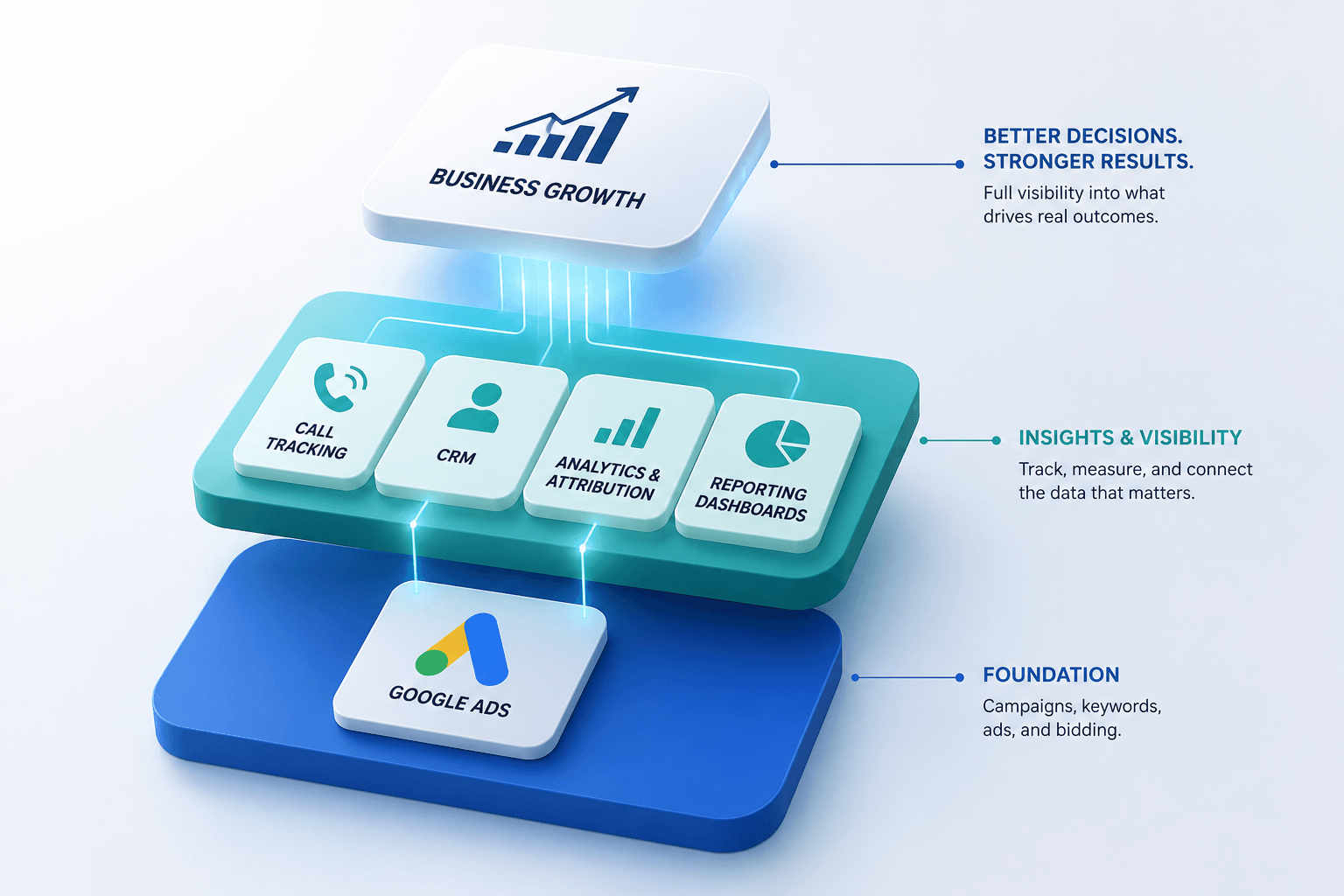
Google Ads is the engine.
But it is not the full operating system.
A business owner usually wants answers like:
- Which campaigns brought in qualified leads?
- Which keywords drove phone calls?
- Which landing pages converted best?
- Which campaigns ‘wasted’ budget?
- Which leads actually turned into revenue?
Google Ads alone cannot answer all of that cleanly.
That is why agencies build a broader stack around it.
What Google Ads shows vs. what agency tools help explain
| Google Ads shows | Agency tools help explain |
| Clicks | Lead quality |
| Conversions | Revenue impact |
| Campaign data | Business insights |
| Spend | What to do next |
That gap matters.
Because most businesses do not have a traffic problem.
They have a visibility problem.
Their data is spread across ad platforms, analytics tools, call recordings, forms, CRMs, and spreadsheets.
A strong Google Ads agency connects those pieces so reporting becomes useful, not just noisy.
Core Google Ads Agency Tool Stack
| Area | Tool Type | Example | Purpose |
| Tracking | Attribution | CallRail | Calls & leads |
| Reporting | Dashboards | Data Studio | Clear insights |
| Optimization | Automation | Optmyzr | Reduce waste |
| AI | Analysis | ChatGPT | Faster decisions |
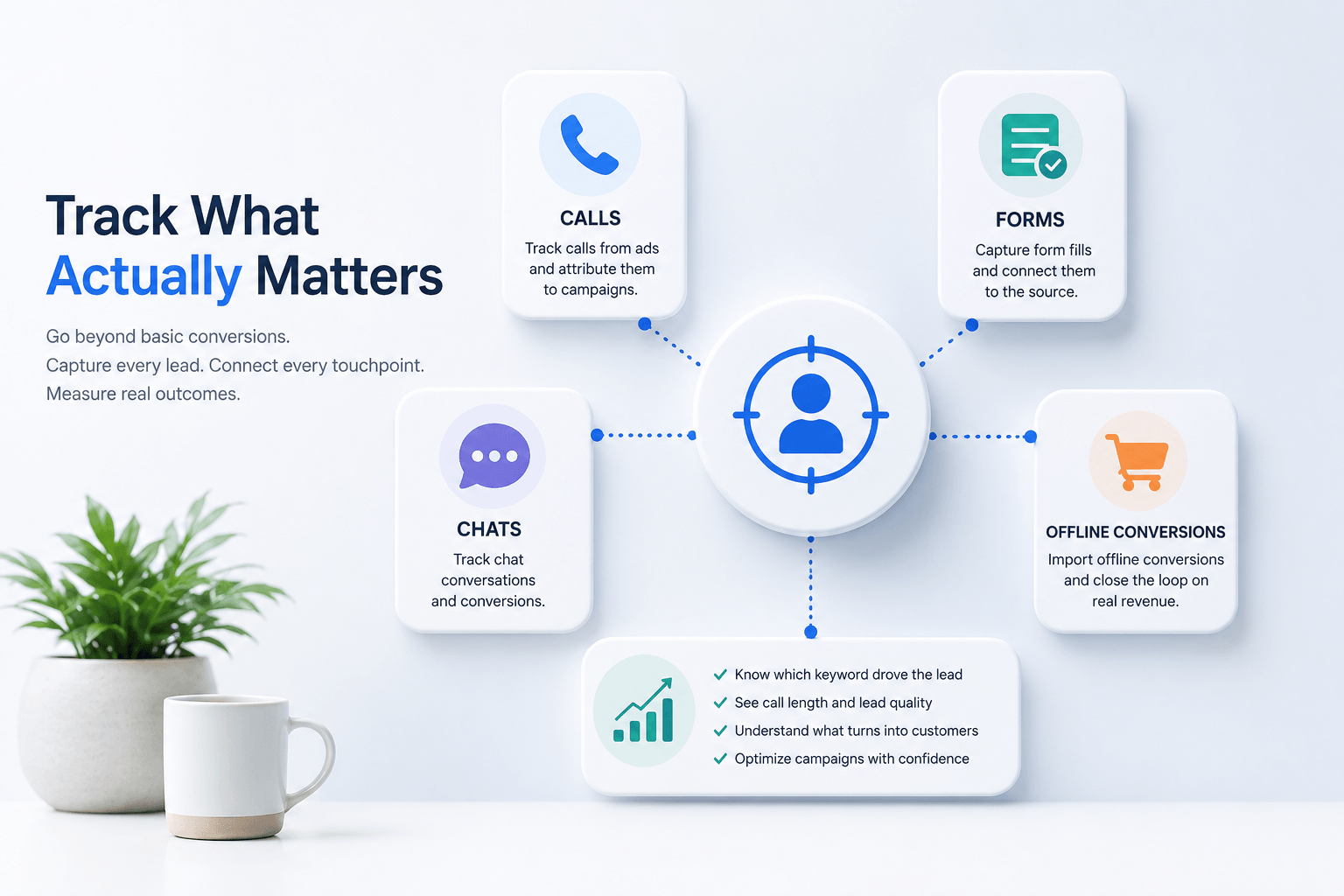
Tracking Tools: Calls, Forms, Chats, and Offline Conversions
This is where weak PPC management usually breaks down.
A form fill is not always a good lead.
A phone call is not always a sales opportunity.
And a campaign that looks great inside Google Ads can still produce poor-quality enquiries.
That is why agencies invest in tracking tools.
Why basic conversion tracking is not enough
Basic setup usually tracks:
- form submissions
- thank-you page visits
- calls from ads
- button clicks
That is a start.
But it still leaves important questions unanswered:
- Which keyword drove the lead?
- How long was the call?
- Was it qualified?
- Did it turn into a customer?
- Which campaigns generated real revenue?
Without that information, optimization becomes guesswork.
Tools agencies use for deeper attribution
WhatConverts helps agencies track calls, forms, chats, and ecommerce activity while tying those leads back to campaigns, keywords, and landing pages.[3]
CallRail adds another important layer by connecting paid clicks to calls, texts, and forms, while also offering conversation intelligence features like transcription and call analysis.[4][5]
Google’s own documentation also supports the value of call conversion tracking. It helps advertisers understand which keywords, ads, ad groups, and campaigns are driving valuable calls.[5]
That is a big deal for lead gen businesses.
Especially in industries like:
- home services
- legal
- healthcare
- real estate
- financial services
Why offline conversion tracking matters
Offline conversion tracking is where Google Ads management gets much more strategic.
Instead of optimizing around raw lead volume, agencies can optimize around:
- qualified opportunities
- closed deals
- sales value
- customer quality
That changes the conversation from “we got conversions” to “we got profitable conversions.”
And that is a much more useful outcome.
Reporting Tools: Dashboards, Connectors, and Client Reporting
Good agencies do not just send screenshots from Google Ads.
They build reporting systems that make performance easier to understand.
That is where reporting tools come in.
What business owners actually want from reports
Most clients do not want more data.
They want clarity.
They want to know:
- what is working
- what is not
- where the budget is going
- whether results are improving
- what should happen next
That is why dashboard tools matter.
Data Studio and reporting connectors
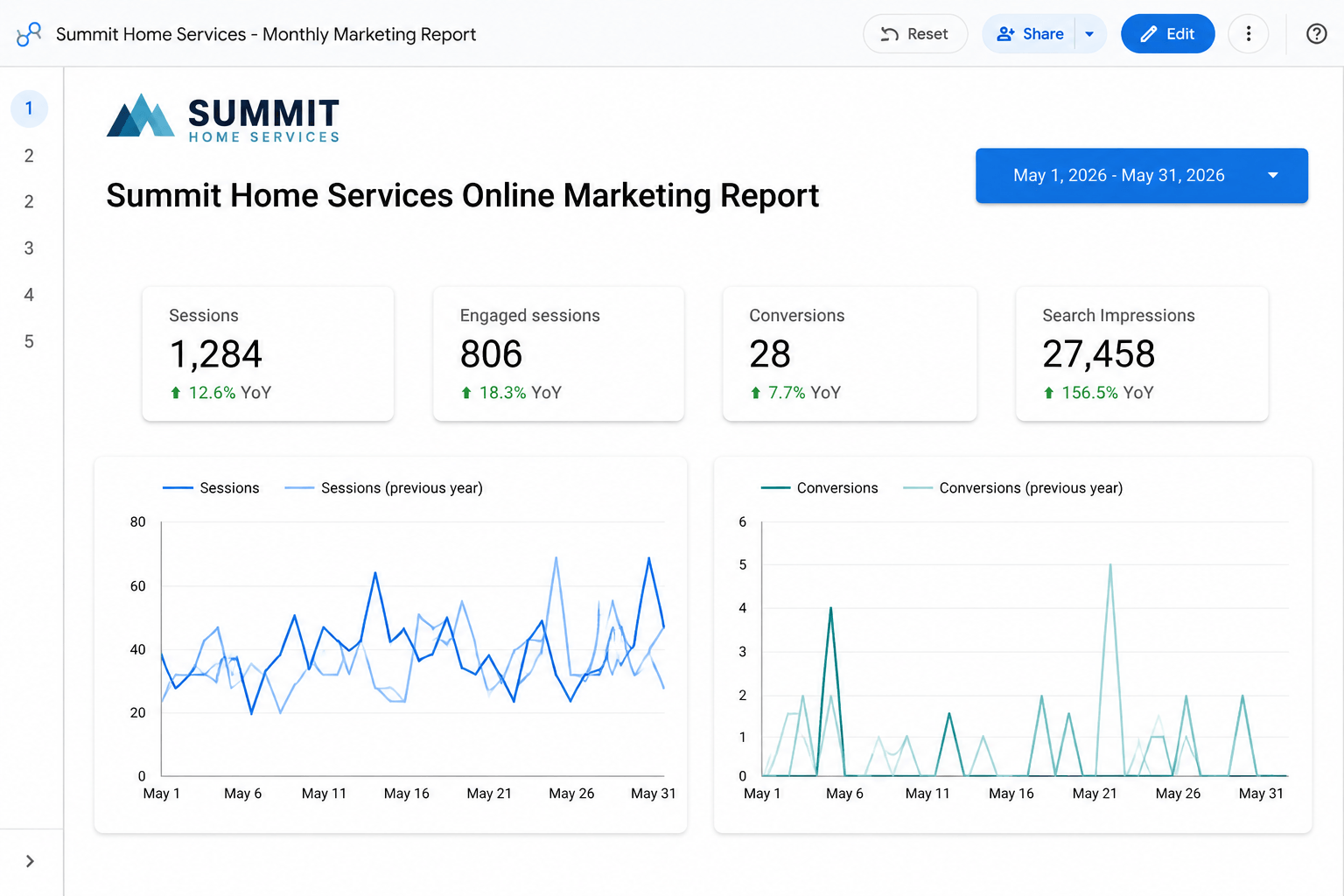
Google describes Data Studio, formerly Looker Studio, as a tool for ad hoc reporting and data visualization across sources like Google Ads, BigQuery, and Google Sheets.[2]
That makes it useful for building cleaner dashboards around:
- cost per lead
- conversion trends
- landing page performance
- ROI patterns over time
Connector tools like Supermetrics make those dashboards more powerful by pulling data from multiple platforms into one place.[6]
And agency reporting platforms like AgencyAnalytics, Swydo, and Whatagraph are built specifically around recurring client reporting, dashboarding, and visibility across channels.[7][8][9]
Why this matters
Without reporting infrastructure, performance data gets trapped in disconnected tools.
With it, agencies can centralize information and spend less time building reports manually.
That creates two advantages:
- clients get clearer visibility
- the agency has more time for actual optimization
Optimization Tools: Spotting Waste Faster and Managing Accounts at Scale
Once an account grows, manual PPC management gets messy fast.
More keywords.
More search terms.
More locations.
More budgets.
More room for wasted spend.
That is why agencies use optimization tools alongside Google Ads.
What these tools actually help with
Optimization platforms help agencies with:
- account monitoring
- budget pacing
- alerts
- search term reviews
- audits
- workflow automation
- issue detection
They do not replace strategy.
They support it.
Common tools agencies use
Optmyzr is positioned around PPC automation, audits, budget monitoring, search query trends, alerts, and workflow tools.[1]
Opteo focuses on recommendations, spend tracking, reporting, and pattern detection across Google Ads accounts.[10]
Adalysis is known for audits, monitoring, optimization analysis, and automation across Google Ads and Microsoft Ads.[11]
WordStream is widely recognized for its Google Ads Performance Grader.[12]
Why this matters for clients
These tools help agencies catch problems earlier.
That can mean spotting:
- wasted spend before it snowballs
- weak search terms before they drain budget
- budget pacing issues before campaigns stall
- structural problems before performance drops
AI Tools: ChatGPT, Gemini, and Claude in Agency Workflows
AI is now part of modern PPC workflows.
Not because it replaces experts.
Because it helps experts move faster.
Where AI actually helps
Agencies are using AI for:
- search term clustering
- reporting summaries
- research
- competitor analysis
- campaign diagnostics
- landing page reviews
- idea generation
The 2025 State of PPC report shows AI adoption in PPC has grown significantly.[13]
HubSpot also reports that 66% of marketers are now using AI in their roles.[14]
Why ChatGPT, Gemini, and Claude matter
These tools are widely used across agencies:
- ChatGPT for research, summaries, and analysis
- Gemini for data-heavy workflows and Google ecosystem integration
- Claude for long-form analysis and structured outputs
The important caveat
AI can significantly improve speed and output quality when used correctly.
For example, research from MIT found that access to ChatGPT reduced task completion time by 40% and improved output quality by 18% in work-related writing tasks.[15]
A Harvard Business School study involving BCG consultants also found that AI users completed tasks faster and produced higher-quality work when operating within AI’s capability range.[16]
At the same time, results declined when tasks required deeper context or fell outside AI’s strengths.
That reinforces the same point:
AI improves efficiency.
But it still depends on human direction, validation, and strategy.
AI can also help generate ideas faster, but high-performing ads still depend on proven messaging frameworks.
Why Agencies Invest in Expensive Software Stacks
Professional Google Ads management is not just a person.
It is a stack.
That stack may include:
- call tracking
- attribution tools
- dashboard software
- connectors
- optimization platforms
- AI tools
And many of these tools are expensive.[1][3][4][6]
Most businesses would not invest in all of them individually.
But agencies do.
Because they can spread those costs across multiple clients.
That gives businesses access to:
- better tracking
- stronger reporting
- deeper insights
- faster optimization
Without needing to build the system internally.
Why Google Ads Agencies Use Advanced Tools (And What It Means for Your Results)
The difference between average and high-performing Google Ads campaigns is not just setup.
It is visibility.
Visibility into:
- which campaigns drive real leads
- which keywords generate revenue
- which channels produce qualified opportunities
- which parts of the funnel are underperforming
That level of visibility does not come from Google Ads alone.
It comes from the combination of:
- tracking tools
- reporting systems
- optimization platforms
- AI-assisted workflows
- and experienced human strategy
Professional Google Ads agencies invest in these systems because they allow for deeper insights, faster optimization, and more accurate decision-making.
And importantly, many of these tools come at a significant cost.
Individually, most businesses would not invest in them.
But agencies spread those costs across multiple clients.
That gives businesses access to a full PPC technology stack — without needing to build it internally.
At the same time, tools alone are not what drive results.
There is always a human behind the process.
Because success in Google Ads is not about more data.
It is about better decisions.
Sources
- Optmyzr Pricing & Features
- Google Data Studio / Looker Studio Overview
- WhatConverts Features & Pricing
- CallRail Pricing
- Google Ads Call Conversion Tracking
- Supermetrics Pricing
- AgencyAnalytics Platform
- Swydo Pricing
- Whatagraph Pricing
- Opteo Pricing
- Adalysis Platform
- WordStream Google Ads Grader
- The State of PPC Survey
- HubSpot AI Trends for Marketers
- State of Marketing AI Report
- MIT Study on ChatGPT Productivity
- Harvard / BCG AI Study
DIGITAL MARKETING SOLUTIONS
Relax.
You've got a digital marketing partner.
Digital Division is a marketing agency with solutions that can help you generate leads and transform your business.