

How to Evaluate a Fractional CMO
(And Choose the Right Partner for Growth)
Hiring a Fractional CMO can be one of the highest-impact decisions you make for your business.
Or one of the most expensive mistakes.
On paper, most fractional CMO services look the same. Strategic guidance. Marketing leadership. Growth planning. But in reality, the difference between the right partner and the wrong one comes down to how they think, how they operate, and whether they can actually drive results beyond theory.
That’s where most businesses get stuck.
They hire someone who talks strategy… but can’t execute.
Or they hire an agency that executes… but lacks real leadership.
What they actually need is both.
In this guide, we’ll break down exactly how to evaluate a fractional CMO candidate step by step, so you can confidently choose a partner who not only builds the strategy—but helps you turn it into measurable growth.

Why Hiring the Right Fractional CMO Matters
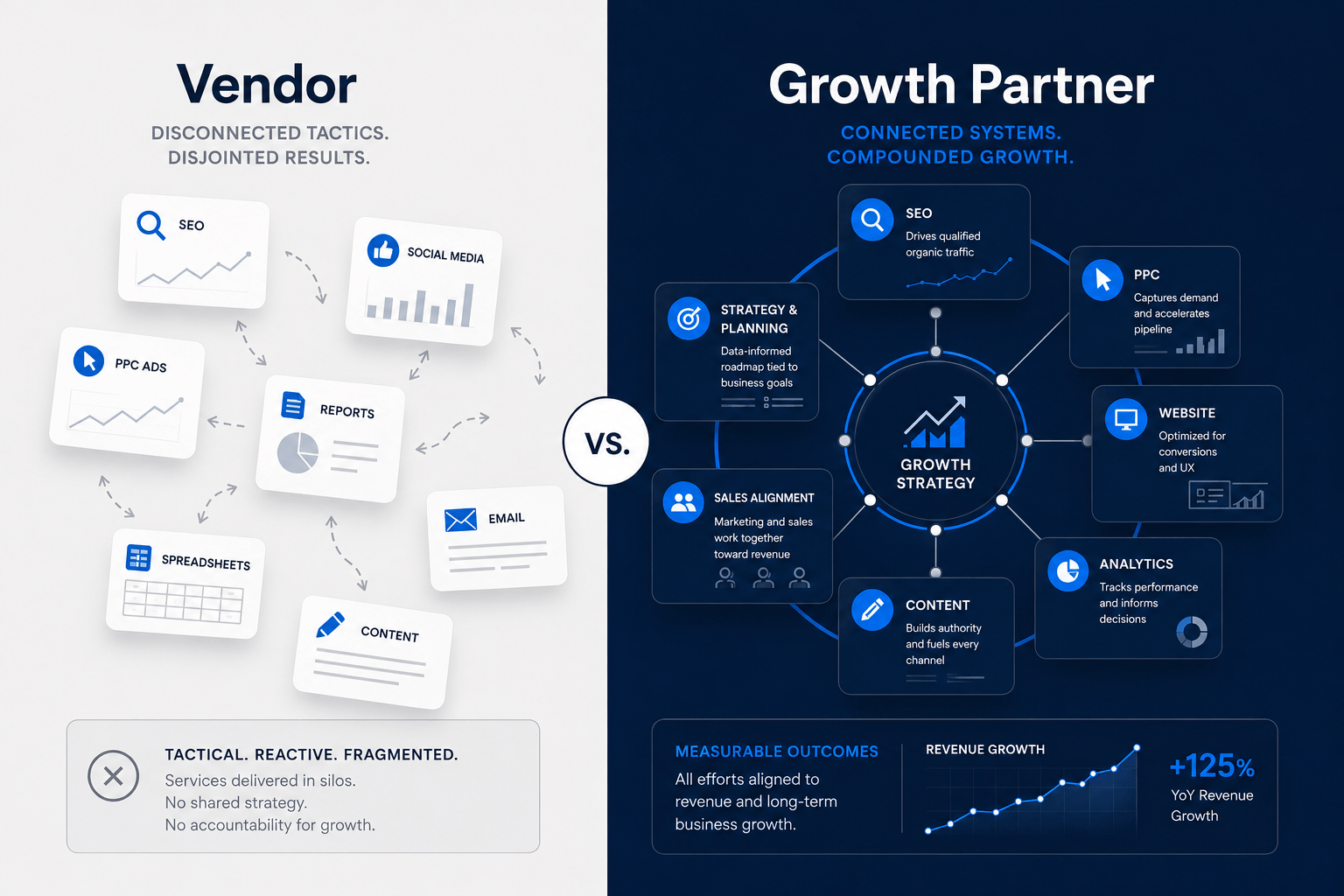
The difference between a vendor and a growth partner
Not all fractional CMOs operate at the same level.
Some act as high-level advisors. They provide recommendations, reports, and direction—but leave execution up to your internal team or other vendors.
Others function as true growth partners.
They step into your business, align marketing with revenue goals, guide decision-making at the leadership level, and ensure the strategy actually gets implemented across every channel.
That distinction matters more than anything else.
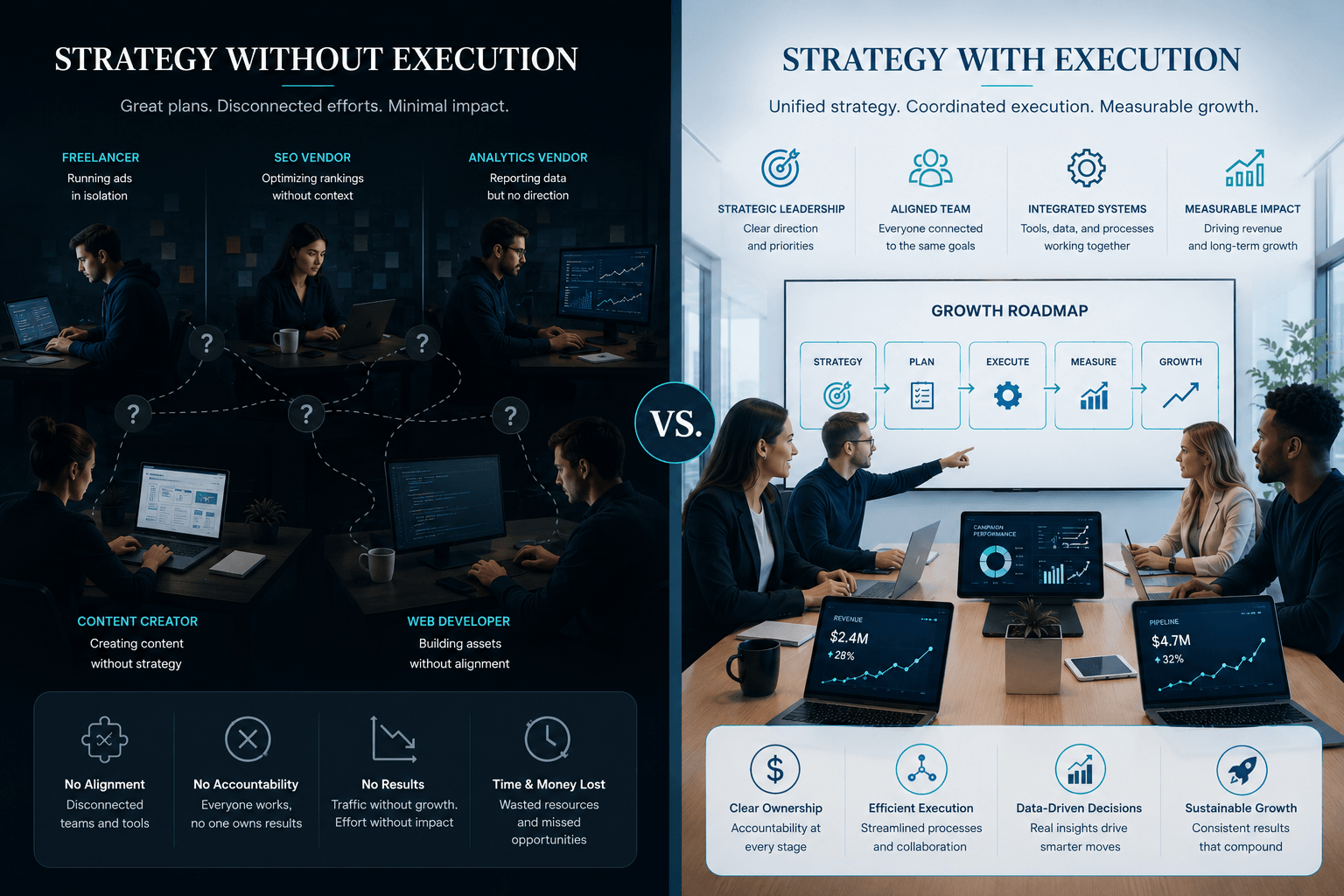
Because marketing strategy without execution doesn’t drive growth.
And execution without strategy leads to wasted budget.
What a great fractional CMO actually does
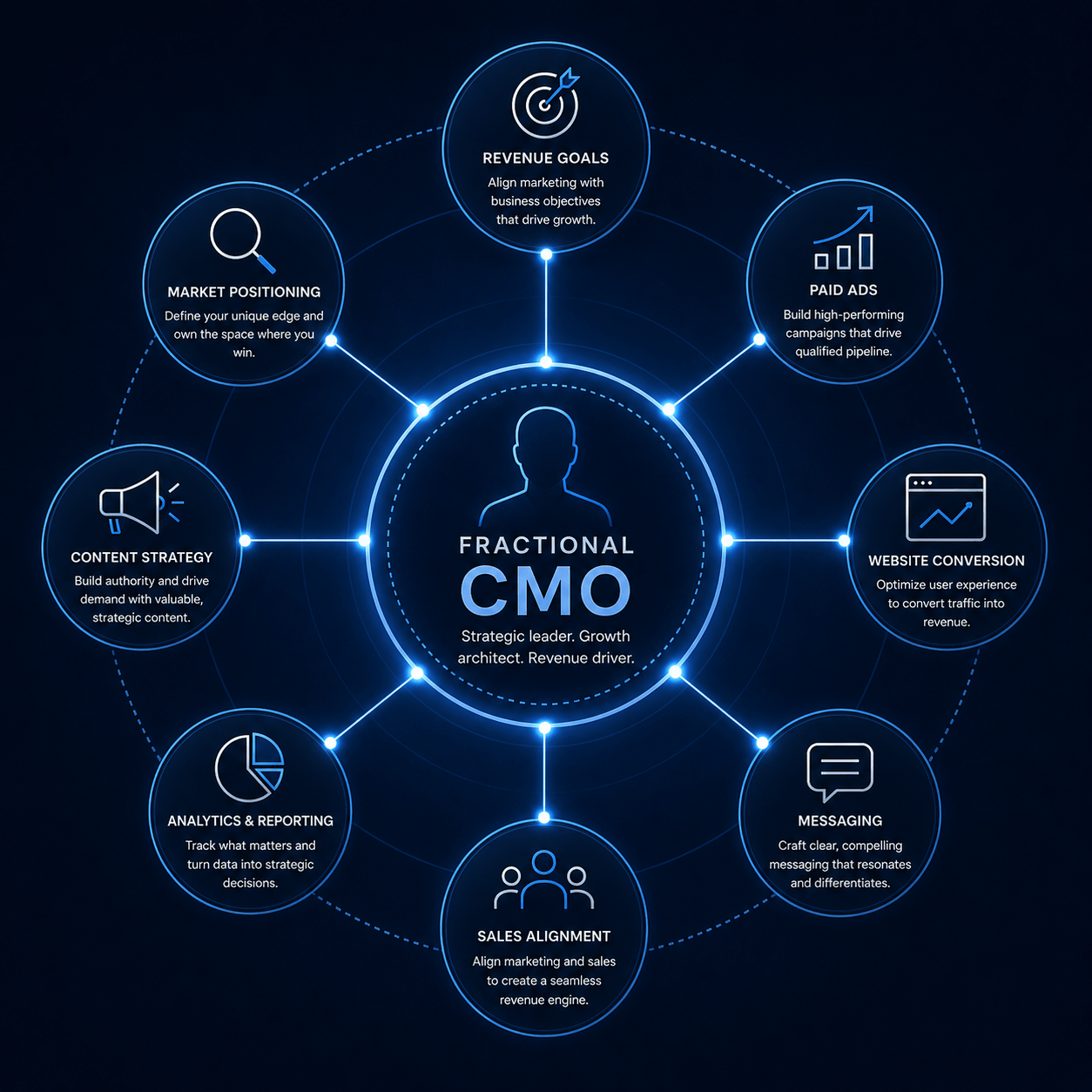
A strong fractional CMO doesn’t just “manage marketing.”
They take ownership of how marketing contributes to business growth.
That includes:
- Defining your positioning in the market
- Aligning marketing with sales and revenue goals
- Identifying the highest-impact growth opportunities
- Prioritizing channels based on ROI, not trends
- Turning data into strategic decisions
- Ensuring execution actually supports the strategy
In other words, they operate at the same level as a full-time CMO—just in a more flexible, cost-efficient model.
Where most businesses go wrong
Most companies don’t fail because they hired a bad marketer.
They fail because they hired the wrong type of marketing support for their stage of growth.
Common mistakes include:
- Hiring based on tactics (SEO, ads, social) instead of strategy
- Choosing the cheapest option instead of the most aligned partner
- Expecting strategy without having execution support in place
- Working with someone who can’t connect marketing to revenue
The result?
Fragmented efforts, inconsistent messaging, and marketing that feels busy—but doesn’t actually move the business forward.
What Fractional CMO Services Should Actually Include
Not all fractional CMO services are built the same.
Some focus purely on strategy. Others lean heavily into execution. The best partners bridge both—connecting high-level business decisions with real, measurable marketing outcomes.
If you're evaluating a fractional CMO candidate, these are the core areas they should be responsible for:
Strategic planning tied to business goals
Everything starts with strategy—but not just marketing strategy.
A strong fractional CMO builds a plan around:
- Revenue targets
- Ideal customer profiles
- Market positioning
- Competitive landscape
- Growth opportunities
This ensures marketing isn’t operating in a silo. It becomes directly tied to how the business grows.
Marketing budget allocation and prioritization
One of the most overlooked responsibilities of a fractional CMO is deciding where to invest.
Instead of spreading budget across every channel, they focus on:
- What will drive the highest ROI
- Which channels match buyer intent
- When to invest vs. when to hold back
- How to scale what’s working
This is where real leverage happens.
Channel strategy and alignment
Fractional CMO services should connect all marketing channels into a single system—not treat them as separate tactics.
That includes aligning:
- SEO as a long-term demand capture strategy
- PPC as a short-term growth accelerator
- Content as authority-building
- Website as the conversion engine
- Social media as visibility and trust
Each channel should support the same core strategy—not compete for attention.
Messaging, positioning, and brand clarity
Before campaigns can perform, the foundation has to be clear.
A fractional CMO should define:
- Who you’re targeting
- What problem you solve
- Why you’re different
- How you communicate that value
Without this clarity, even well-executed campaigns struggle to convert.
Performance tracking and decision-making
Reporting isn’t about dashboards—it’s about decisions.
A strong fractional CMO focuses on:
- Revenue and pipeline impact
- Cost per acquisition
- Conversion rates across the funnel
- Channel performance relative to goals
And most importantly:
They use that data to adjust strategy—not just report on it.
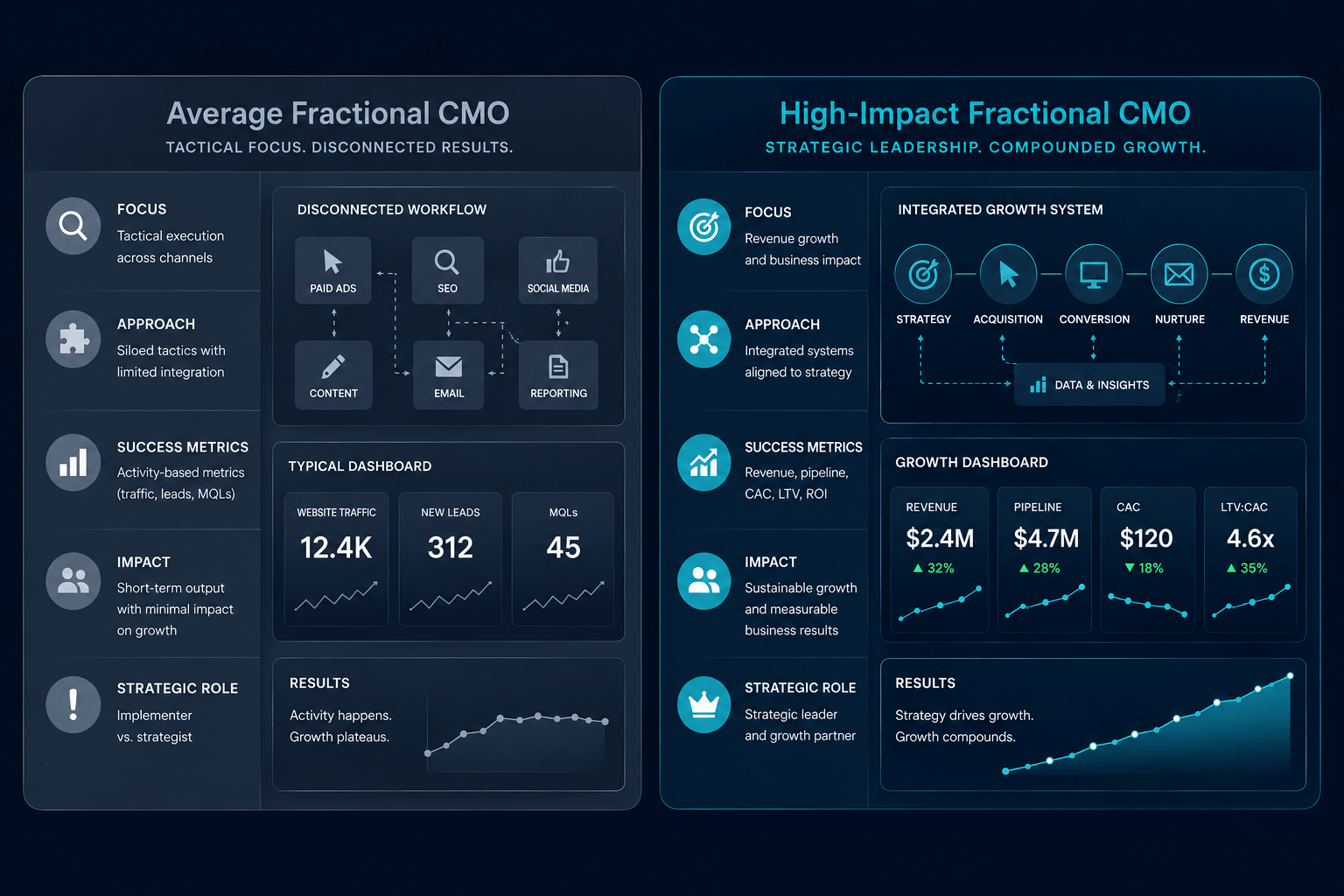
What Separates Average vs High-Impact Fractional CMO Services
Here’s a quick way to evaluate the difference:
| Area | Average Fractional CMO | High-Impact Fractional CMO |
| Strategy | Channel-focused | Business-driven |
| Execution | Left to others | Integrated with strategy |
| Metrics | Traffic & leads | Revenue & ROI |
| Role | Advisor | Growth partner |
Key takeaway:
If a fractional CMO can’t connect strategy to execution—and execution to revenue—you’re not getting a true growth partner. You’re getting a consultant.
How to Evaluate a Fractional CMO Candidate (Step-by-Step)
Choosing the right fractional CMO isn’t about reviewing a resume.
It’s about understanding how they think, how they make decisions, and whether they can actually drive growth inside your business.
Here’s a simple framework you can use to evaluate any candidate with confidence:
Step 1: Define Your Business Outcome First
Before you evaluate anyone, get clear on what success looks like.
Most hiring mistakes happen because businesses start with:
“Who should we hire?”
Instead of:
“What are we trying to achieve?”
A strong fractional CMO will expect clarity around:
- Revenue goals
- Growth targets
- Timeline expectations
- Current bottlenecks (leads, conversion, positioning, etc.)
If you skip this step, even the best strategist will struggle to deliver results.
What to look for:
A candidate who pushes you to define outcomes before proposing solutions.
Step 2: Evaluate Their Strategic Thinking (Not Just Tactics)
This is where most candidates separate themselves.
Anyone can talk about SEO, paid ads, or content.
But a true fractional CMO connects marketing to business outcomes.
Pay attention to how they answer questions.
Do they say:
- “We should run Google Ads and improve SEO”
Or:
- “Based on your goals, we need to prioritize demand capture first, then build long-term authority through SEO”
That difference is everything.
What to look for:
- They start with business goals, not channels
- They explain why a strategy makes sense
- They connect marketing decisions to revenue impact
Step 3: Look for a Clear Framework or Process
Great fractional CMOs don’t “wing it.”
They follow a structured approach to diagnosing problems and building strategy.
This might include:
- Market and competitor analysis
- Customer and messaging research
- Channel prioritization
- Funnel and conversion optimization
- Performance tracking systems
If they can’t clearly explain how they approach a new engagement, that’s a red flag.
What to look for:
- A repeatable process they can walk you through
- Clear phases (strategy - execution - optimization)
- Confidence in how they approach different scenarios
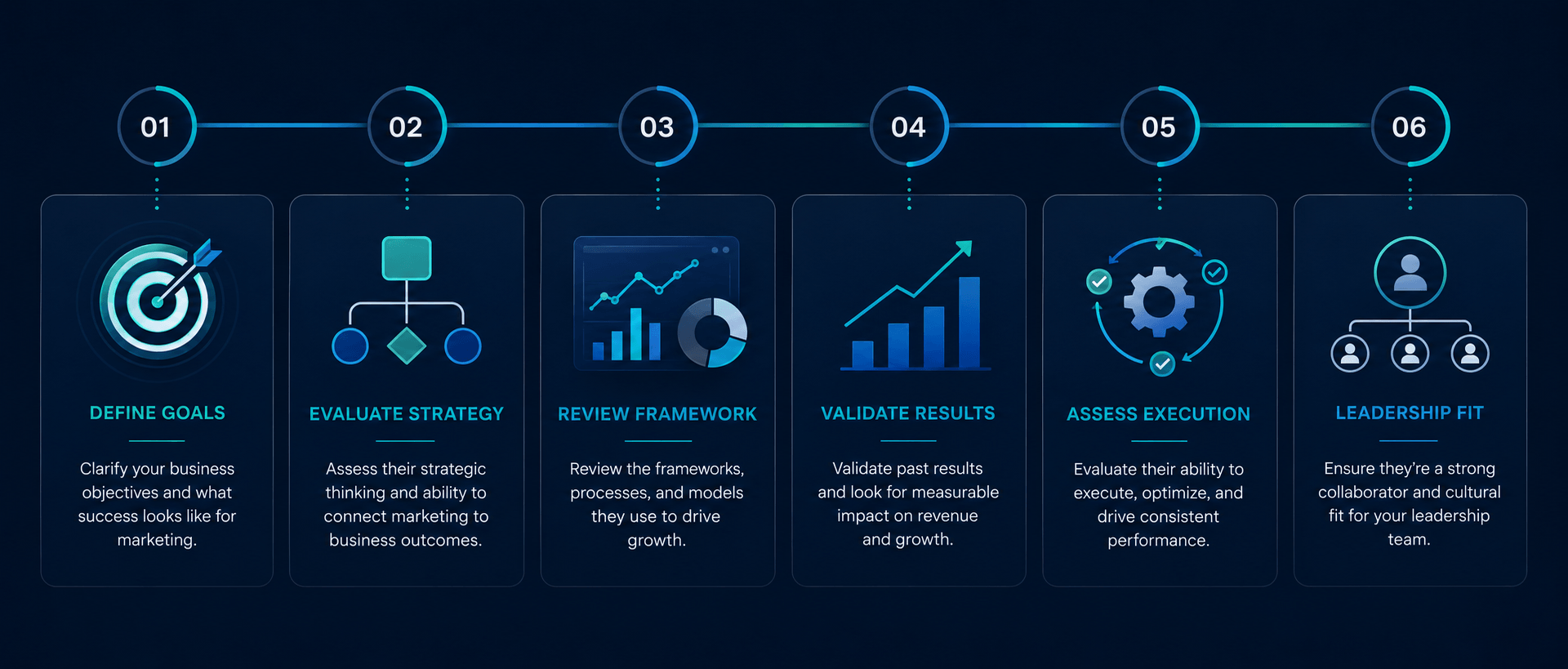
Step 4: Validate Past Results (The Right Way)
Most candidates will show case studies.
But not all results are created equal.
Instead of focusing on vanity metrics like traffic or impressions, dig deeper.
Ask questions like:
- What was the business problem?
- What changed after you got involved?
- How did revenue, leads, or conversion rates improve?
- What specific actions drove those results?
You’re not just validating outcomes—you’re validating how they think.
What to look for:
- Clear before-and-after impact
- Specific metrics tied to business outcomes
- The ability to explain why something worked
Step 5: Assess Their Ability to Execute (Critical)
This is one of the biggest gaps in the market.
Many fractional CMOs provide strategy… and stop there.
That leaves you responsible for:
- Hiring specialists
- Managing vendors
- Coordinating execution
- Ensuring consistency across channels
A high-impact partner doesn’t just build the strategy.
They ensure it gets implemented correctly.
What to look for:
- Do they have a team or execution capability?
- Can they oversee implementation across channels?
- Will they stay involved beyond the strategy phase?
This is where businesses often see the biggest difference in results.
Step 6: Evaluate Communication and Leadership Fit
A fractional CMO isn’t just a marketer.
They’re stepping into a leadership role.
That means they need to:
- Communicate clearly with founders and executives
- Align marketing with sales and operations
- Guide decision-making, not just suggest ideas
- Push back when needed
If they can’t operate at that level, they won’t be effective.
What to look for:
- Confidence in leadership conversations
- Ability to simplify complex ideas
- Willingness to challenge assumptions
- Strong communication style
Quick Evaluation Checklist
If you want a fast way to assess a candidate, use this:
- Do they start with business goals?
- Can they clearly explain their strategy?
- Do they have a defined process?
- Can they prove real business impact?
- Do they support execution—not just planning?
- Can they operate at a leadership level?
If you can confidently answer “yes” to all of these, you’re likely looking at a strong candidate.
7 Questions to Ask Before Hiring a Fractional CMO
If you’re evaluating a fractional CMO candidate, the right questions will tell you more than any resume or case study.
Use these to quickly understand how they think, how they operate, and whether they’re the right fit for your business.
1. How do you approach building a growth strategy?
This question reveals whether they think like a strategist—or just a tactician.
Strong answers will include:
- Business goals first
- Market positioning
- Customer insights
- Channel prioritization based on ROI
Weak answers jump straight into tactics like SEO, ads, or social media.
2. How do you decide which marketing channels to prioritize?
Not every channel matters equally.
A strong fractional CMO will explain:
- How they evaluate opportunity vs. effort
- How they align channels with buyer intent
- When to focus vs. when to expand
If they say “you should be everywhere,” that’s a red flag.
3. How do you measure success?
This question separates surface-level reporting from real business impact.
Look for answers tied to:
- Revenue growth
- Cost per acquisition
- Conversion rates
- Pipeline contribution
If they focus only on traffic, impressions, or clicks, they’re missing the bigger picture.
4. What does your process look like from start to finish?
You’re looking for structure here.
Strong candidates will walk you through:
- Discovery and research
- Strategy development
- Execution planning
- Ongoing optimization
If the process feels vague or inconsistent, expect inconsistent results.
5. How do you handle execution after the strategy is built?
This is one of the most important questions you can ask.
Some fractional CMOs:
- Deliver a strategy and step away
Others:
- Stay involved and ensure execution happens
The second option is where real results come from.
6. How do you align marketing with sales and revenue goals?
Marketing doesn’t operate in isolation.
A strong answer should include:
- Collaboration with sales teams
- Funnel alignment
- Lead quality—not just lead volume
- Feedback loops between marketing and revenue
This is where strategy turns into actual growth.
7. Can you share a specific example of how you drove measurable growth?
This is your reality check.
Push for specifics:
- What was the problem?
- What did you change?
- What were the results?
- What impact did it have on the business?
You’re not just looking for success—you’re looking for clarity in how they achieved it.
Quick Tip
If a candidate struggles to answer these questions clearly, it usually means one of two things:
- They don’t have a structured approach
- Or they haven’t operated at a true strategic level
Either way, it’s a signal to dig deeper—or keep looking.
Red Flags to Watch Out For When Evaluating a Fractional CMO
Not every fractional CMO is equipped to drive real business growth.
Some sound impressive in conversations—but fall short when it comes to strategy, execution, or results.
Here are the biggest red flags to watch for:
Over-focus on tactics instead of strategy
If every recommendation revolves around channels like SEO, PPC, or social media without tying back to business goals, that’s a problem.
Marketing tactics are tools—not the strategy itself.
A strong fractional CMO should start with:
- Growth objectives
- Market positioning
- Customer behavior
Not:
- “Let’s run ads”
- “Let’s post more content”
No clear framework or process
If they can’t explain how they approach strategy, execution, and optimization, expect inconsistency.
Great operators follow a structured process.
Without that, decisions become reactive instead of intentional.
They can’t connect marketing to revenue
This is one of the most common issues.
If they focus on:
- Traffic
- Engagement
- Impressions
But struggle to explain:
- Revenue impact
- Lead quality
- ROI
They’re operating at a surface level.
Strategy without execution support
Many fractional CMOs stop at the strategy phase.
That leaves you responsible for:
- Hiring specialists
- Managing vendors
- Coordinating campaigns
And in most cases, that’s where things break down.
Without proper execution, even the best strategy won’t produce results.
Generic, one-size-fits-all recommendations
If their approach sounds the same regardless of your industry, business model, or goals, that’s a red flag.
Strong fractional CMOs tailor strategy based on:
- Your market
- Your competitive landscape
- Your specific growth challenges
Not a templated playbook.
Limited involvement after the initial engagement
Some candidates are highly involved upfront—but disappear once the strategy is delivered.
You need someone who:
- Stays engaged
- Monitors performance
- Adjusts strategy over time
- Guides execution continuously
Growth doesn’t happen from a one-time plan.
Quick Reality Check
If you’re hearing:
- “We’ll increase traffic”
- “We’ll run campaigns”
- “We’ll improve engagement”
But not:
- “Here’s how we drive revenue”
- “Here’s how we prioritize growth opportunities”
- “Here’s how we execute and scale”
You’re likely not talking to a true strategic partner.
Fractional CMO vs Marketing Agency (What’s the Difference?)
One of the most common questions businesses have is:
“Should we hire a fractional CMO… or work with a marketing agency?”
The answer depends on what you actually need.
Because while both can support growth, they play very different roles.
Quick Comparison
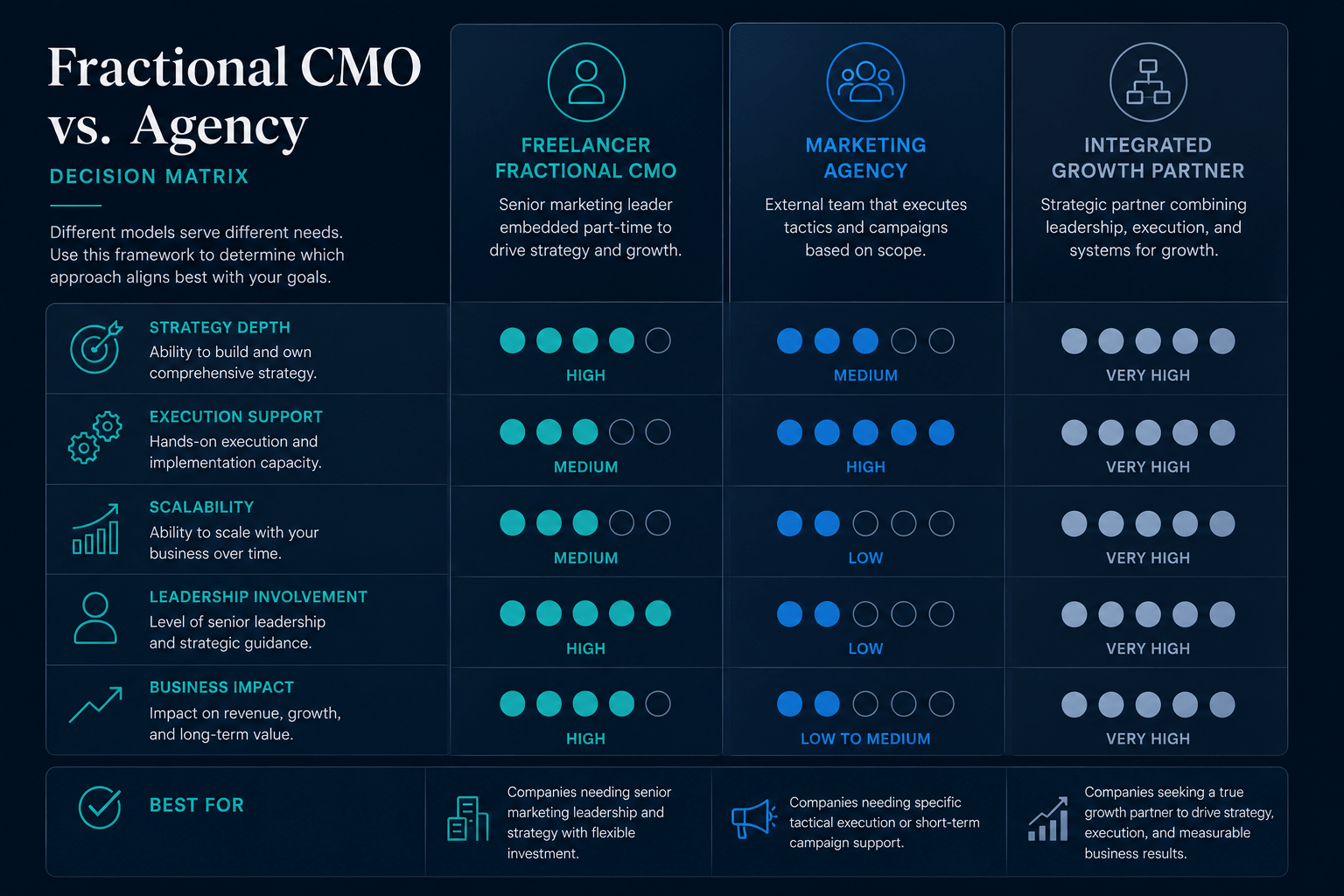
| Option | Best For | Limitation |
| Freelancer Fractional CMO | High-level strategy | No execution support |
| Marketing Agency | Campaign execution | Limited strategic leadership |
| Fractional CMO + Execution Partner(Digital Division) | Strategy + leadership + execution | Built as a growth partner |
The key difference comes down to this:
- Freelance fractional CMOs typically focus on strategy
- Agencies typically focus on execution
- Very few provide both in a fully integrated way
And that gap is where most businesses struggle.
They either:
- Get a strategy with no clear path to execution
- Or get execution without a cohesive strategy
Neither leads to consistent, scalable growth.
Why integration matters
Marketing doesn’t fail because of a single channel.
It fails when strategy, messaging, and execution aren’t aligned.
For example:
- SEO drives traffic, but the website doesn’t convert
- PPC generates leads, but messaging isn’t clear
- Content is created, but it doesn’t support positioning
Without a unified strategy guiding execution, performance becomes inconsistent.
What a true growth partner looks like
The most effective model combines:
- Strategic leadership (what to do and why)
- Execution support (making it happen)
- Ongoing optimization (improving over time)
This is where fractional CMO services become significantly more valuable—when they don’t operate in isolation.
Key takeaway:
If you have to stitch together strategy, execution, and performance tracking across multiple vendors, growth becomes harder than it needs to be.
How Digital Division Approaches Fractional CMO Services
At Digital Division, we don’t view fractional CMO services as a consulting role.
We see it as a leadership role.
That means stepping into your business, understanding how it grows, and guiding the decisions that move it forward—not just recommending marketing tactics.
Strategy comes first—but it doesn’t stop there
Many fractional CMOs focus only on building strategy.
We take it further.
We start by understanding:
- Your business goals and revenue targets
- Your market and competitive landscape
- Your positioning and messaging
- Where your biggest growth opportunities exist
From there, we build a clear, focused strategy designed to drive measurable outcomes—not just activity.
We connect strategy directly to execution
A strategy is only as valuable as its implementation.
That’s why we don’t hand off a plan and step away.
We ensure the strategy is carried through across every key area:
- SEO as a demand capture engine
- PPC as a growth accelerator
- Website as a conversion platform
- Content as authority-building
- Messaging as the foundation for all channels
Everything works together as part of a unified system—not disconnected efforts.
We operate as part of your leadership team
Our role isn’t to act like an external vendor.
It’s to function as an extension of your leadership team.
That means:
- Helping you make informed marketing investment decisions
- Aligning marketing with sales and business objectives
- Prioritizing initiatives based on impact—not noise
- Providing clarity in situations where direction is unclear
We’re not just executing campaigns—we’re helping guide the direction of growth.
We focus on outcomes, not activity
Marketing can easily become busy without being effective.
We focus on what actually matters:
- Driving qualified leads
- Improving conversion rates
- Increasing revenue from marketing efforts
- Building systems that scale over time
Every decision ties back to business impact.
The difference in approach
Most options force you to choose between:
- Strategy without execution
- Or execution without strategy
Digital Division is built to provide both—backed by a team that can actually implement what’s been planned.
That combination is what turns marketing from a set of activities into a true growth system.
Bottom line:
We don’t just help you plan your marketing. We help you build and execute a strategy that drives real, measurable growth.
Ready to Find the Right Fractional CMO for Your Business?
Choosing the right partner can define how your business grows over the next 12–24 months.
If you’re evaluating fractional CMO services or trying to determine whether it’s the right move, we can help you get clarity before you commit.
Book a strategy call to:
- Identify your biggest growth opportunities
- Understand what kind of marketing leadership you actually need
- See how a fractional CMO model would apply to your business
FAQs About Fractional CMO Services
What does a fractional CMO do?
A fractional CMO provides part-time marketing leadership focused on strategy, growth planning, and performance oversight.
They help businesses:
- Define marketing strategy
- Align marketing with revenue goals
- Prioritize channels and investments
- Guide execution and optimization
Unlike a full-time CMO, they work on a flexible basis while still operating at a leadership level.
How much do fractional CMO services cost?
Costs can vary widely depending on experience, scope, and level of involvement.
Most fractional CMOs charge:
- Monthly retainers
- Hourly rates
- Or project-based fees
In general, businesses choose this model because it provides executive-level marketing leadership without the cost of a full-time hire.
How many hours does a fractional CMO work?
It depends on the needs of the business.
Some engagements are:
- A few hours per week for strategic guidance
- More involved roles that include ongoing leadership and execution oversight
The scope should align with your growth goals and internal resources.
Do I need a fractional CMO or a full-time CMO?
A fractional CMO is typically the better fit if:
- You need strategic leadership but aren’t ready for a full-time executive
- You want to improve performance without building a large internal team
- You need flexibility as your business grows
A full-time CMO may make sense at later stages when marketing complexity increases significantly.
Can a fractional CMO manage my existing team or vendors?
Yes—this is often a key part of the role.
A strong fractional CMO will:
- Align your internal team
- Manage external vendors or agencies
- Ensure all efforts support a unified strategy
This helps eliminate fragmentation and improves overall performance.
How long should I work with a fractional CMO?
Most engagements are ongoing because growth requires continuous optimization.
However, timelines can vary based on:
- Business goals
- Stage of growth
- Internal capabilities
The most successful partnerships tend to be long-term, where strategy and execution evolve together.
Choosing the Right Fractional CMO Is a Growth Decision—Not Just a Marketing One
Hiring a fractional CMO isn’t just a marketing decision.
It’s a growth decision.
The right partner will help you:
- Clarify your strategy
- Align your marketing with revenue
- Execute consistently across channels
- Build systems that scale over time
The wrong one will leave you with disconnected tactics, unclear direction, and missed opportunities.
That’s why taking the time to properly evaluate a fractional CMO candidate is critical.
Because when you get it right, marketing stops feeling like a cost—and starts becoming a true driver of growth.
DIGITAL MARKETING SOLUTIONS
Relax.
You've got a digital marketing partner.
Digital Division is a marketing agency with solutions that can help you generate leads and transform your business.